blank'/>

Astrophotography banner

Saturday, October 25, 2014

Milky Way over Yellowstone National Park Old Faithful geyser Night Sky Landscape Astrophotography Canon 60Da

Yellowstone National Park is famous for its geysers and wildlife, but after sunset it becomes one of the most remarkable dark-sky locations in the United States. On this clear October night, I photographed the Milky Way rising above Old Faithful Geyser using a Canon 60Da. The mixture of starlight, geothermal steam, and the silence of the geyser basin created an unforgettable nightscape.


The green color near the horizon is natural airglow — a faint emission from the upper atmosphere — not light from the geyser. The combination of airglow, steam, and the bright Milky Way core created an almost surreal view of Yellowstone’s night sky.
Milky Way over Old Faithful Geyser in Yellowstone National Park at night, long-exposure landscape captured with Canon 60Da astrophotography.
Milky Way over Yellowstone National Park Old Faithful geyser Night Sky Landscape Astrophotography Canon 60Da

Camera Equipment and Settings 

  • Camera: Canon 60Da (astrophotography edition)
  • Lens: Canon EF 16–35mm f/2.8L II USM
  • Aperture: f/2.8
  • Exposure Time: 30 seconds
  • ISO: 3200
  • Focus: Manual, set on a bright star
  • Technique: Single long exposure on tripod

A Missing Native American Legend

There are countless legends about the Milky Way across world cultures. Every civilization described it through metaphors, animals, and stories that reflected their own worldview. Since Yellowstone was sacred land for many Native American tribes — and since many tribal stories were not shared with outsiders — very few Yellowstone-specific Milky Way legends survive today.

Last year my daughter was learning about Native American traditions, and I asked her to create a “missing” Yellowstone legend — one that connects Old Faithful, nature, and the Milky Way. 
Here is the legend she wrote:
      
                                         The geyser, crow, corn, and the Milky Way

During fall the Native Americans were harvesting corn. One day a crow came, it wanted back some of the corn it gave to the Native Americans. It kept stealing the corn until the village made noise shakers and scared the crow away. While the crow was flying away holding corn in its beak, a geyser erupted and the corn kernels flew out of the crow’s beak. The crow chased it into the sky. From this day forward the corn kernels became the stars, and the dust has become the Milky Way.

Pretty much it is very close to what you see on picture above.

Interesting Scientific Note

Recently astronomers discovered enormous “galactic geysers” near the center of the Milky Way — giant outflows of gas rising thousands of light-years above the galactic core. In a way, this science echoes the legend: geyser-like eruptions shaping the appearance of our galaxy. Different level of understanding, same beautiful imagery.


There is supervolcano night sky video on youtube. A supereruption of Yellowstone volcano will affect all word. Nobody knows when it happens. Geyser eruptions show that the Yellowstone giant volcano is still active, it just sleeping under wide and starry sky.

Related Yellowstone Astrophotography Posts

Wednesday, October 22, 2014

Halloween Astrophotography - Night, New Moon, Street-Lamp and Spider Web

This photo was not taken on Halloween, but the moment I reviewed it the scene naturally reminded me of a classic Halloween mood — a new moon behind thin clouds, a glowing street lamp, and a spider resting on its web. I captured this atmospheric moment near Yellowstone Lake Hotel while testing a new lens. The weather was not suitable for deep-sky photography, but sometimes small details create their own story.

Just after sunset, only the moon was visible in the sky while thin clouds drifted across it. The warm light of the street lamp illuminated the spider on its delicate web, giving the scene an unexpected, almost cinematic feel. 


Moonlit scene at Yellowstone Lake Hotel with thin clouds, a glowing street lamp and a spider on its web creating a natural Halloween-like atmosphere.
Halloween Astrophotography - Night, New Moon, Street-Lamp and Spider Web
 

Camera Settings

  • Camera: Canon 60Da
  • Lens: Canon  EF 200mm f/2.8 L II USM Telephoto Lens
  • Exposure: 1/400 sec
  • Aperture: f/2.8
  • ISO: 3200
  • Notes: Fast shutter to preserve natural brightness of moon and lamp

About the Lens

For this image I was testing my Canon EF 200mm f/2.8L II USM, a telephoto prime lens well known for its excellent sharpness and simple optical design. Unlike zoom lenses with many internal elements, a prime lens typically offers better contrast and fewer distortions — especially useful in astrophotography where precision matters. Since most night-sky photography does not require zoom, this lens is a great match for capturing small illuminated subjects or atmospheric details.

About This Photo

Even though this was not a Halloween night, the elements came together — moonlight, thin clouds, spider, and lamp — to create a scene with a Halloween-like character. This small moment became a unique part of my Yellowstone astrophotography series.

Related Yellowstone Astrophotography Posts

Location

Yellowstone Lake Hotel, Yellowstone National Park, Wyoming, USA

Saturday, October 18, 2014

Grand Teton National Park Nightscape Astrophotography Colter Bay Village Starry Sky Canon 60Da

The beauties of sky in the absolute silence of one of the dark place in the word - Grand Teton National Park. Nightscape or starscape astrophotography Canon 60Da, Colter Bay Village

Grand Teton National Park Nightscape Astrophotography Colter Bay Village Starry Sky Canon 60Da
  Camera Canon 60Da; Wide Angle Lens EF16-35mm f/2.8L II USM; Exposure 20.0 sec; f/2.8; ISO 4000

Night Sky Grand Teton - Canon 60Da
  Camera Canon 60Da; Wide Angle Lens EF16-35mm f/2.8L II USM; Exposure 8.0 sec; f/2.8; ISO 4000

Grand Teton Starry Night Sky
   Camera Canon 60Da; Wide Angle Lens EF16-35mm f/2.8L II USM; Exposure 20.0 sec; f/2.8; ISO 4000

Dark Earth cloud crossing the Milky Way over Grand Teton National Park night sky, captured with Canon EOS 60Da on tripod
UFO Cloud and Milky Way Grand Teton Astrophotography Night Sky Canon 60Da
  
On this quiet night in Grand Teton, I noticed an unusual dark cloud moving slowly across the Milky Way. It wasn’t a deep-space shadow, but a real Earth cloud, illuminated only by starlight.
Under urban skies near New York, clouds glow from light pollution and never appear dark — but here, without moonlight and artificial glow, the same cloud became an inky silhouette against the stars.
I waited until it drifted over the brightest part of the Milky Way, creating the illusion of a UFO-shaped shadow floating across the galaxy. Camera Canon 60Da; Wide Angle Lens EF16-35mm f/2.8L II USM; Exposure 30.0 sec; f/2.8; ISO 4000

In light-polluted areas, clouds always appear bright because they reflect city lights. But under a real dark sky, clouds can look darker than the surrounding sky — even black — because there’s no artificial light to illuminate them. When such a cloud passes over the Milky Way, it briefly hides millions of stars, forming a dramatic silhouette that looks almost supernatural.

Starry Sky Reflection Grand Teton Astrophotography
Night Sky Grand Teton Milky Way Astrophotography
Milky Way and Colter Bay Cabin Astrophotography

There is YouTube video


Wednesday, October 15, 2014

Yellowstone Night Landscape – Geyser Eruption (Canon 60Da Astrophotography)

During this night in Yellowstone I had only a short window of clear sky, so I photographed Old Faithful during one of its nighttime eruptions. In some images (Image 1, Image 2, and Image 7) the geyser is captured at the peak of its activity, when the steam column rises very high and fills much of the frame even with a wide-angle lens. In the other photos the geyser shows its normal continuous steam, which is still bright and impressive at night but not as large as during the peak. After the strongest burst, the dew and moisture were so intense that I had to warm the lens before continuing photography.

All images were taken with the Canon 60Da and the Canon EF 16–35mm f/2.8L II USM wide-angle lens — an excellent combination for night landscapes and astrophotography thanks to its bright aperture and clean optical design.

Image 1 – Peak Eruption (Horizontal)

Peak nighttime eruption of Old Faithful in Yellowstone with a massive steam column filling the horizontal wide-angle frame.
Yellowstone Night Landscape Geyser eruption Canon 60Da

Camera Canon 60Da; Wide Angle Lens EF16-35mm f/2.8L II USM; Exposure 30.0 sec; f/2.8; ISO 4000

This horizontal image captures Old Faithful at the peak of its eruption. The steam column fills most of the frame, showing how large it appears when photographed up close with a wide-angle lens.

Image 2 – Peak Eruption with Milky Way (Vertical)

Vertical nighttime photo of Old Faithful peak eruption in Yellowstone with rising steam and part of the Milky Way visible.
Yellowstone Geyser eruption and the Milky Way
 
Camera Canon 60Da; Wide Angle Lens EF16-35mm f/2.8L II USM; Exposure 30.0 sec; f/2.8; ISO 4000

A vertical composition taken from the same location as Image 1. The strong eruption rises upward, and a portion of the Milky Way appears beside the plume. Through the steam you can see the silhouette of a nearby hotel building.

Image 3 – Three Geysers + Pleiades

Night landscape in Yellowstone showing three geysers erupting with the Pleiades star cluster above.
Yellowstone night sky Geyser astrophotography Canon 60Da
  
Camera Canon 60Da; Wide Angle Lens EF16-35mm f/2.8L II USM; Exposure 15.0 sec; f/2.8; ISO 3200

From a different angle, this photo shows three geysers: the main plume, a smaller geyser, and a tiny third one. Above them shines the Pleiades star cluster (Seven Sisters).

Image 4 – Black & White Astrophotography + Airglow

Black and white long-exposure photo of Old Faithful geyser steam at night showing natural airglow as bright clouds.
Yellowstone night  photography - black and white - Old Faithful Geyser
   
Camera Canon 60Da; Wide Angle Lens EF16-35mm f/2.8L II USM; Exposure 30.0 sec; f/2.8; ISO 4000

This long-exposure black-and-white image shows how differently a camera sees the night compared to human eyes. A camera can expose for 30 seconds or more, while our eyes collect light for only a fraction of a second. The bright green airglow seen in photos appears as white or grayish clouds to the naked eye.

Image 5 – Steam, Trees and Milky Way

Night view of Yellowstone geyser steam with foreground trees and the Milky Way rising above the scene.
Milky Way Galaxy Over Yellowstone National Park Starry night Sky Astrophotography Canon 60Da
   
Camera Canon 60Da; Wide Angle Lens EF16-35mm f/2.8L II USM; Exposure 30.0 sec; f/2.8; ISO 4000

A different angle introduces trees in the foreground while the Milky Way rises behind the drifting steam.

Image 6 – Milky Way, Airglow and Water Reflections

Night landscape in Yellowstone featuring geyser steam, Milky Way core, green airglow and water reflections on the ground.
Yellowstone Park Milky Way Galaxy Geyser Airglow Night Sky Landscape Astrophotography
 
Camera Canon 60Da; Wide Angle Lens EF16-35mm f/2.8L II USM; Exposure 30.0 sec; f/2.8; ISO 3200

A beautiful combination of the Milky Way, glowing green airglow, geyser steam and water reflecting light on the ground.

Image 7 – Peak Eruption + Pleiades

Photo of Old Faithful peak eruption with the Pleiades star cluster visible high in the sky.
Yellowstone eruptions and Pleiades seven sisters M45 Astrophotography
 Camera Canon 60Da; Wide Angle Lens EF16-35mm f/2.8L II USM; Exposure 15.0 sec; f/2.8; ISO 3200

A strong eruption reaching upward with the Pleiades star cluster clearly visible at the top of the frame.

Image 8 – Forest Background + Pleiades

Yellowstone nighttime scene showing geyser steam with a forest background and the Pleiades star cluster above.
Pleiades and geyser Yellowstone night starry sky landscape Canon 60da

In this composition the forest becomes visible behind the geyser field, and the Pleiades star cluster appears clearly in the night sky.

Image 9 – Distant View with Foreground Trees

Far-view nighttime photo of Yellowstone geyser steam with trees in the foreground.
Yellowstone starry night astrophotography Canon 60Da

This final image is taken from a distant position. Trees in the foreground add scale to the geyser steam rising into the night sky.

Camera Equipment

  • Camera: Canon 60Da astrophotography DSLR
  • Lens: Canon EF 16–35mm f/2.8L II USM
  • Aperture: f/2.8
  • Exposure: 15-30 sec
  • ISO: 3200-4000
  • Mode: Manual, tripod mounted

Related Yellowstone Astrophotography Posts

Monday, October 13, 2014

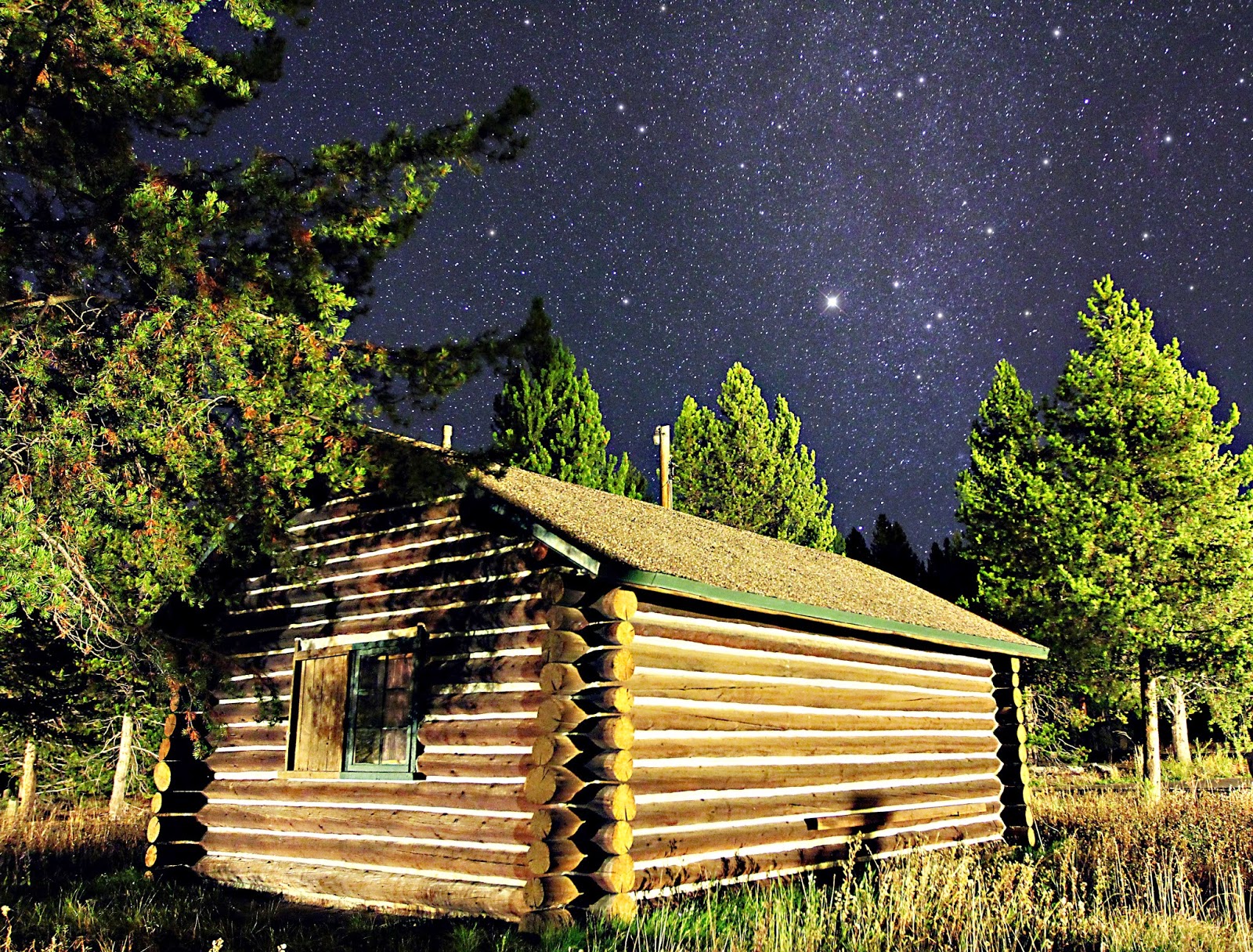
Reflection of Ursa Major (Big Dipper) Grand Teton Nightscape Astrophotography Canon 60Da

Night sky at Grand Teton is so dark that you can easily see reflections of the stars. Jackson Lake, Colter Bay, Grand Teton National Park – reflection of the Big Dipper (Ursa Major constellation). You can see green airglow near the horizon and “star paths” — lengthened reflections of stars caused by slightly agitated water.

As simple as possible.

Reflection of Big Dipper on Jackson Lake with green airglow Grand Teton National Park Canon 60Da
Reflection of Ursa major (Big Dipper)  Grand Teton Nightscape Astrophotography Canon 60Da

Canon 60Da; Canon Wide Angle Lens EF16-35mm f/2.8L II USM; Exposure 15 sec; f/2.8; ISO 4000.

Related Astrophotography Posts

Thursday, October 9, 2014

Grand Teton Astrophotography Wyoming National Park

Philosophy is written in that great book which
ever lies before our eyes — I mean the universe
— but we cannot understand it if we do not first
learn the language and grasp the symbols,
in which it is written.

--Galileo Galilei


Milky way over Grand Teton National park. There is combination of three photos.

Grand Teton Astrophotography  Wyoming National Park Canon 60Da

Canon 60Da; Lens EF16-35mm f/2.8L II USM; Exposure 30.0 sec; f/2.8; ISO 4000


Two interesting effect are visible on this photo. If sky stars don't have big trails, reflections of stars have pretty much visible "star roads". Actually every star reflection has its own "star path" like Moon reflection has moonpath. When stars more close to horizon than "star path" of reflection is longer. Reflection stars near horizon also looks brighter because of near horizon light from starts more parallel to water surface and has bigger reflectivity. 


Monday, October 6, 2014

Big Dipper (Ursa Major constellation) over Old Faithful geyser Yellowstone Wyoming Astrophotography

During my nights in Yellowstone National Park I photographed one of the most familiar northern-sky constellations — the Big Dipper, the famous asterism of Ursa Major — rising above the famous Old Faithful geyser. Even without a major eruption, the drifting steam created a beautiful and dramatic foreground for the stars.

These images were captured with the Canon 60Da, a camera designed specifically for astrophotography, paired with a Canon EF 16–35mm f/2.8L II USM wide-angle lens. This lens is excellent for nightscapes thanks to its bright aperture and clean optical design, which helps preserve star shapes and capture faint details in the sky.

In both images you can see a faint green glow near the horizon. This is not light pollution — it is airglow, a natural atmospheric emission that becomes especially visible in true dark-sky locations like Yellowstone.

Big Dipper and Old Faithful

Big Dipper above the low steam of Old Faithful geyser in Yellowstone, captured with a wide-angle lens under a sky with visible airglow.
Big Dipper (Ursa Major constellation) over Old Faithful geyser, Yellowstone National Park, Wyoming Astrophotography Canon 60Da

In this first image the Big Dipper appears clearly in the middle-right part of the frame. On the left side, the geyser’s steam rises high toward the upper edge of the photo, adding movement and depth to the scene. The wide-angle composition allows both the landscape and the constellation to be captured in a single frame without distortion.

The clarity of the stars together with the drifting steam and natural airglow creates a surreal atmosphere that only a dark, quiet night in Yellowstone can offer.

Big Dipper above the Geyser Basin – Wide View

Big Dipper high above the steam of Old Faithful geyser in Yellowstone, photographed from a wider distance with a visible band of sky airglow.
Night Sky and Big Dipper over sleeping Yellowstone Supervolcano

The second image was taken from a greater distance, showing the geyser basin more fully. Here the entire Big Dipper stands over the geyser steam, and the wider view reveals more of the sky’s natural airglow. The combination of drifting steam, cold night air, and a pristine dark sky creates an amazing, almost magical atmosphere in the photo.

Camera Settings

  • Camera: Canon 60Da astrophotography DSLR
  • Lens: Canon EF 16–35mm f/2.8L II USM (wide-angle)
  • Exposure: 30 seconds
  • Aperture: f/2.8
  • ISO: 4000
  • Mode: Manual, tripod mounted

Related Astrophotography Posts

Saturday, October 4, 2014

Grand Teton Milky Way Astrophotography

Reflections of Stars, Milky Way and green Airglow - Gran Teton National park - Colter Bay Wyoming  September 25, 2014.

Grand Teton Milky Way Astrophotography Lake Reflection Canon 60Da

Camera Canon 60Da; Lens EF16-35mm f/2.8L II USM; Exposure 16.0 sec; f/2.8; ISO 4000

The night sky at Grand Teton national park is amazing! On photo you can see reflection of stars and even reflection of Milky Way! Milky Way is really very bright in the Grand Teton. Also you can see green airglow near horizon (which visible only in clear sky) and even reflection of the airglow. The green color is natural for clear sky without light pollution. 

Milky Way Grand Teton
Camera Canon 60Da; Lens EF16-35mm f/2.8L II USM; Exposure 16.0 sec; f/2.8; ISO 4000

Thursday, October 2, 2014

Yellowstone Milky Way


Milky Way in the Yellowstone National park is amazing. I was three days in Yellow stone, first day in Yellowstone Lake Hotel, next day in Mammoth hotel and last day in Old Faithfull hotel. First two night and days it was raining and I missed nice views which I saw in the photos of other people. Finally I was lucky near Old Faithfull Geyser. Sky is so dark that stars looks like lamps and Milky Way is really just fantastic!

YelowStone MilkyWay and Old Faithful Geyser Canon 60Da
 Canon 60Da;  Lens EF16-35mm f/2.8L II USM; Exposure 20.0 sec;   f/2.8;   ISO 3200

Wednesday, October 1, 2014

Yellowstone Astrophotography

During my trip to Yellowstone National Park the weather was mostly cloudy and rainy, and for several days I thought I would not be able to photograph the night sky at all. Yellowstone is famous for dramatic weather changes, and this trip proved it. Clouds, fog, and rain covered the park almost continuously. 


Only on the very last night, shortly before midnight, the sky suddenly cleared for a couple of hours. It felt like a miracle. I rushed outside with my camera, knowing this might be my only chance. By the next morning it was raining again — so I was extremely lucky to catch this short window of perfectly clear sky. Yellowstone Astrophotography Old Faithful Geyser at night Canon 60Da    Canon Lens EF 16-35mm f2.8L II USM Ultra Wide. 
Yellowstone astrophotography of Old Faithful Geyser at night under starry sky taken with Canon 60Da and Canon EF 16-35mm f/2.8L II.

Yellowstone is one of the darkest and most impressive places I have photographed. The quality of the sky is excellent, with very little light pollution, and the combination of geothermal features and the Milky Way creates a truly unique atmosphere. All images were taken with a Canon 60Da camera paired with the Canon EF 16–35mm f/2.8L II USM ultra-wide lens, a great setup for capturing wide night landscapes. Exposure time 30 sec; f/2.8; ISO 4000. 
One of the most surprising and beautiful elements in these photos is the foreground. Normally, it is very difficult to capture natural color and detail on the ground at night. But in this case, soft light from the nearby hotel illuminated the grass and the area around Old Faithful just enough to make it visible, without overpowering the stars. This gentle lighting worked perfectly and added a sense of depth to the landscape.
Yellowstone starry sky night landscape panorama photographed with Canon 60Da — two-image night-scape astrophotography.
Yellowstone Starry Sky Night Landscape Photography - Panorama Night-scape Astrophotography Panorama of two images - Exposure time 30 sec; f/2.8; ISO 4000


Seeing Old Faithful Geyser under the stars was unforgettable. The steam rising into the cold night air, the illuminated grass in the foreground, and the star-filled sky above created a scene that looked almost prehistoric — like the Earth a million years ago. The combination of geothermal activity and a dark, crystal-clear sky made the whole landscape feel timeless.
This short window of clear sky turned what I expected to be a completely cloudy trip into one of the most memorable astrophotography experiences I have had. Yellowstone at night is magical, and I hope these images capture a little of that feeling.

Related Astrophotography Posts


Tuesday, September 2, 2014

Canada Astrophotography

Canada Astrophotography  Ontario Toronto Golf course
Canada Astrophotography Rainbow Bridge between Canada and USA near Niagara Falls
Night landscape Canada
Niagara falls Canada Astrophotography Canon 60Da Wide filed
Niagara falls Nightscape

Monday, August 25, 2014

Top 10 amateur astrophotography targets


There is my list of top 10 objects for beginners in astrophotography

1.    Milky Way
2.    Northern Lights and airglow and bioluminescence
3.    Star trails and/or photography of meteor shower
4.    Zodiacal Light
5.    Moon
6.    Sun
7.    Saturn
8.    Jupiter
9.    Solar Eclipse
10.   Lunar Eclipse


Milky Way View From Earth - Yellowstone
Night Scape Astrophotography Award Astronomyforum.net 3rd Quarter 2014

StarTalk radio chose my photo - Grand Teton Milky Way
Universe Today posted my image Yellowstone Astrophotography
Yellowstone Astrophotography photo was couple of days in Google News
NYC Solar eclipse photo was chosen by Yahoo news as Best-of Flickr week photo

Tuesday, August 19, 2014

Monday, August 4, 2014

Astrophotography little planet at night polar panorama

Astrophotography - tiny planet at night - Photoshop Filter - Polar Coordinate.. Manhattan.

Astrophotography little planet at night polar panoramas
Ladder to the Sky - Manhattan 360 Degrees Panorama polar coordinate
Little Planet - Tower of David Jerusalem Israel - 360 Panorama
Little Planet Brooklyn Sheepshead Bay

Thursday, July 24, 2014

Canon 60Da Milky Way Tripod Ultra Wide Angle Astrophotography Summer Triangle

This is my first deep and detailed Milky Way photo captured with the Canon EOS 60Da. I took this image in the Catskills, Upstate New York, under much darker skies compared to Brooklyn. The 60Da’s enhanced H-alpha sensitivity and special IR-cut filter reveal far more Milky Way structure than my older Canon 40D ever could.

Using an ultra-wide-angle Canon EF 16–35mm f/2.8L II lens on a fixed tripod, the 60Da captured thousands of faint stars and intricate nebulae in a single wide field centered on the Summer Triangle (Vega, Deneb, Altair).

Canon 60Da Milky Way Ultra Wide Angle Astrophotography Summer Triangle Upstate New York
Canon 60Da Milky Way Ultra Wide Angle Astrophotography Summer Triangle  Tripod Catskills Upstate NY New York

Constellations and Deep-Sky Objects Visible

This wide field contains an incredible number of stars — my software detected over 10,000 stars in a single frame. It covers many constellations:

  • Cygnus, Lyra, Delphinus, Lacerta, Sagitta
  • Parts of Cepheus, Equuleus, Pegasus, Draco, Aquila

Several famous deep-sky nebulae and clusters are visible, including:

  • IC 1396 – Elephant’s Trunk Nebula
  • NGC 7000 – North America Nebula
  • IC 5070 & IC 5067 – Pelican Nebula
  • IC 1318 – Gamma Cygni Nebula
  • IC 5146 – Cocoon Nebula
  • IC 1311 – Sadr Region
  • Veil Nebula (supernova remnant)
  • Dark nebulae: Triple Cave (Aquila), Le Gentil 3 (Cygnus)
  • Beginning of the Great Rift in the Milky Way
  • Open clusters: M29, NGC 6885, NGC 6940
  • Brocchi’s Cluster (Coathanger)
 Canon 60Da LCD screen showing astrophotography settings
Canon 60Da setting

Exposure details:
Canon 60Da + Canon EF 16–35mm f/2.8L II
Fixed tripod (no tracker)
f/2.8, ISO 12800, 9 seconds each
Total imaging time: ~20 minutes (stacked in DeepSkyStacker)

Canon 60Da astrophotography tripod setup anti-dew heater remote timer
Canon 60Da Astrophotography - Tripod, Timer Remote and anti-Dew Dew-Not

The daytime photo of the setup shows the full equipment used for this shot: the Canon 60Da mounted on a sturdy tripod, a remote interval timer for consistent exposures, and an anti-dew heating strip (Dew-Not) wrapped around the lens. Dew control is especially important during summer nights in the Catskills to keep the lens clear for long imaging sessions. This simple and portable setup is ideal for wide-field Milky Way photography when traveling without a star tracker.


Canon EOS 60Da Milky Way Astrophotography annotated deep sky wide field Summer Triangle
Wide Field Astrophotography Canon 60Da Milky Way - annotated

The annotated version of the Milky Way image shows just how rich this region of the sky is. By labeling the nebulae, dark clouds, open clusters, and constellation patterns, the annotation helps visualize how much structure the Canon 60Da can capture with only a fixed tripod and a wide-angle lens. It also highlights how well the 60Da’s enhanced H-alpha sensitivity brings out emission nebulae like the North America Nebula, Pelican Nebula, Gamma Cygni region, and Cocoon Nebula.

Related Astrophotography Posts