blank'/>

Astrophotography banner

Showing posts with label Night photo. Show all posts

Tuesday, March 13, 2018

Crux (Southern Cross), Milky Way and Palm Tree - Galapagos Night Sky Astrophotography

The Galápagos Islands offer a rare opportunity to photograph the southern night sky from an equatorial location. In this image, the sky is filled with southern-hemisphere highlights rarely visible from mid-northern latitudes.

Prominently visible are Alpha Centauri — the closest stellar system to our Solar System — the distinctive Crux (Southern Cross) constellation, and the faint glow of the South Celestial Pole. A palm tree in the foreground provides a natural tropical frame, emphasizing the unique location and latitude.


Crux Southern Cross Milky Way and palm tree over Galapagos Islands equatorial night sky astrophotography
Crux  (Southern Cross), Milky Way  and Palm Tree - Galapagos Night Sky Astrophotography

Image details:
Panorama of 3 frames
Canon EOS 60Da · Canon EF 16–35mm f/2.8L II USM
16 s · f/2.8 · ISO 6400
Puerto Villamil, Isabela Island, Galápagos, Ecuador

The South Celestial Pole in this image is located using two independent geometric methods. The first method uses the Crux (Southern Cross) constellation: a line extended along the long axis of Crux points toward the south celestial pole.

The second method uses Alpha Centauri and Beta Centauri. By drawing an imaginary line connecting these two bright stars and then constructing a perpendicular line through the midpoint between them, this perpendicular also points toward the south celestial pole.

When both constructions are applied to the same image, the Crux axis line and the Centauri perpendicular intersect very close to the south celestial pole. The annotated image above shows this intersection clearly.


Annotated southern sky showing Crux axis and Alpha Beta Centauri perpendicular intersecting at the South Celestial Pole
The South Celestial Pole - Galapagos Equator Sky - Annotated

From this image, the south celestial pole appears very close to the horizon. Because Isabela Island lies on the equator, this photograph captures a true equatorial sky — a rare vantage point where the geometry of Earth and the celestial sphere becomes visually apparent.

Related Galápagos & Equatorial Sky Astrophotography:

Saturday, October 18, 2014

Grand Teton National Park Nightscape Astrophotography Colter Bay Village Starry Sky Canon 60Da

Grand Teton National Park is one of the few places in the United States where night truly returns to its natural state. Far from cities and artificial glow, the sky above Colter Bay reveals not only stars and the Milky Way, but also subtle atmospheric and optical effects that are invisible under light-polluted skies.

These nightscape images were captured near Colter Bay Village under moonless, pristine dark-sky conditions. Here, the Milky Way appears intensely detailed, reflections form easily on still water, and even ordinary clouds behave differently — no longer glowing from below, but appearing as dark silhouettes against the star field.

This post focuses on a different aspect of dark-sky astrophotography than my other Grand Teton images. Rather than reflections or monumental structure, it explores how darkness itself changes perception — revealing effects that can feel unusual, even surreal, simply because we are no longer accustomed to seeing the night sky as it truly is.

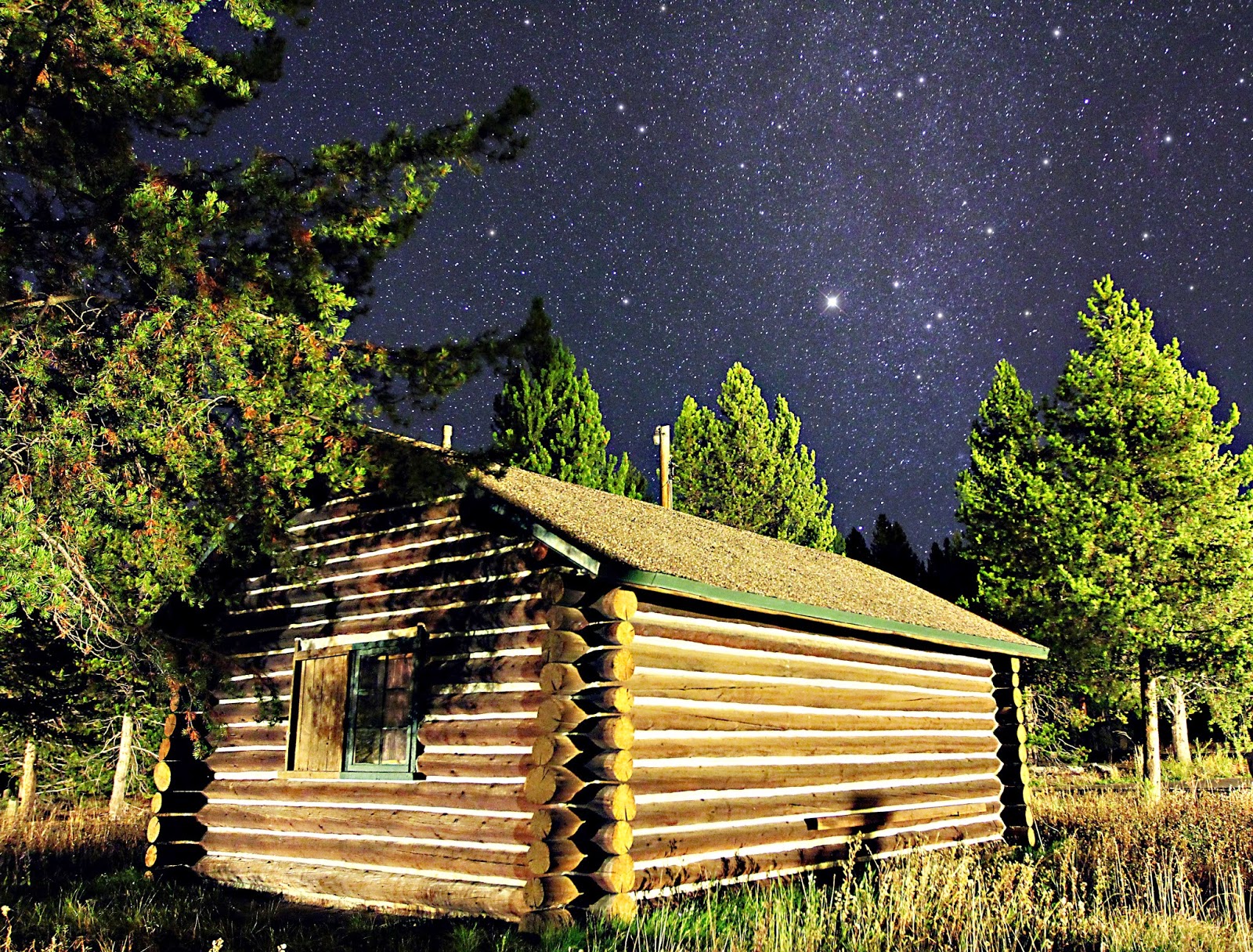
Starry night sky above a cabin at Colter Bay Village in Grand Teton National Park under dark skies
Grand Teton National Park Nightscape Astrophotography Colter Bay Village Starry Sky Canon 60Da

  Camera Canon 60Da; Wide Angle Lens EF16-35mm f/2.8L II USM; Exposure 20.0 sec; f/2.8; ISO 4000

Starry night sky above forest trees in Colter Bay Village, Grand Teton National Park
Night Sky Grand Teton - Canon 60Da
  
Camera Canon 60Da; Wide Angle Lens EF16-35mm f/2.8L II USM; Exposure 8.0 sec; f/2.8; ISO 4000

Starry night sky above trees with cabins between them at Colter Bay Village in Grand Teton National Park
Grand Teton Starry Night Sky
   Camera Canon 60Da; Wide Angle Lens EF16-35mm f/2.8L II USM; Exposure 20.0 sec; f/2.8; ISO 4000

Dark Earth cloud crossing the Milky Way over Grand Teton National Park night sky, captured with Canon EOS 60Da on tripod
UFO Cloud and Milky Way Grand Teton Astrophotography Night Sky Canon 60Da
  

On this quiet night in Grand Teton, I noticed an unusual dark cloud moving slowly across the Milky Way. It wasn’t a deep-space shadow, but a real Earth cloud, visible only because the sky was truly dark.

Under urban skies near New York, clouds glow from light pollution and never appear dark — but here, without moonlight and artificial glow, the same cloud became an inky silhouette against the stars.

Under truly dark skies, clouds can appear darker than the sky itself because they block starlight rather than reflect artificial light from below. When such a cloud passes over the Milky Way, it briefly hides millions of stars and forms a dramatic silhouette that can look almost supernatural.

I waited until it drifted over the brightest part of the Milky Way, creating the illusion of a UFO-shaped shadow floating across the galaxy.

Camera Canon 60Da; Wide Angle Lens EF16-35mm f/2.8L II USM; Exposure 30.0 sec; f/2.8; ISO 4000


Reflections of stars on calm lake water at Grand Teton National Park during a moonless night
Starry Sky Reflection Grand Teton Astrophotography

Milky Way rising between two trees above the Teton Range at Colter Bay in Grand Teton National Park
Night Sky Grand Teton Milky Way Astrophotography

Milky Way above the roof of a cabin at Colter Bay Village in Grand Teton National Park
Milky Way and Colter Bay Cabin Astrophotography

Grand Teton Night Sky Video

There is YouTube video


Grand Teton Astrophotography Series

Wednesday, October 15, 2014

Yellowstone Night Landscape – Geyser Eruption (Canon 60Da Astrophotography)

During this night in Yellowstone I had only a short window of clear sky, so I photographed Old Faithful during one of its nighttime eruptions. In some images (Image 1, Image 2, and Image 7) the geyser is captured at the peak of its activity, when the steam column rises very high and fills much of the frame even with a wide-angle lens. In the other photos the geyser shows its normal continuous steam, which is still bright and impressive at night but not as large as during the peak. After the strongest burst, the dew and moisture were so intense that I had to warm the lens before continuing photography.

All images were taken with the Canon 60Da and the Canon EF 16–35mm f/2.8L II USM wide-angle lens — an excellent combination for night landscapes and astrophotography thanks to its bright aperture and clean optical design.

Image 1 – Peak Eruption (Horizontal)

Peak nighttime eruption of Old Faithful in Yellowstone with a massive steam column filling the horizontal wide-angle frame.
Yellowstone Night Landscape Geyser eruption Canon 60Da

Camera Canon 60Da; Wide Angle Lens EF16-35mm f/2.8L II USM; Exposure 30.0 sec; f/2.8; ISO 4000

This horizontal image captures Old Faithful at the peak of its eruption. The steam column fills most of the frame, showing how large it appears when photographed up close with a wide-angle lens.

Image 2 – Peak Eruption with Milky Way (Vertical)

Vertical nighttime photo of Old Faithful peak eruption in Yellowstone with rising steam and part of the Milky Way visible.
Yellowstone Geyser eruption and the Milky Way
 
Camera Canon 60Da; Wide Angle Lens EF16-35mm f/2.8L II USM; Exposure 30.0 sec; f/2.8; ISO 4000

A vertical composition taken from the same location as Image 1. The strong eruption rises upward, and a portion of the Milky Way appears beside the plume. Through the steam you can see the silhouette of a nearby hotel building.

Image 3 – Three Geysers + Pleiades

Night landscape in Yellowstone showing three geysers erupting with the Pleiades star cluster above.
Yellowstone night sky Geyser astrophotography Canon 60Da
  
Camera Canon 60Da; Wide Angle Lens EF16-35mm f/2.8L II USM; Exposure 15.0 sec; f/2.8; ISO 3200

From a different angle, this photo shows three geysers: the main plume, a smaller geyser, and a tiny third one. Above them shines the Pleiades star cluster (Seven Sisters).

Image 4 – Black & White Astrophotography + Airglow

Black and white long-exposure photo of Old Faithful geyser steam at night showing natural airglow as bright clouds.
Yellowstone night  photography - black and white - Old Faithful Geyser
   
Camera Canon 60Da; Wide Angle Lens EF16-35mm f/2.8L II USM; Exposure 30.0 sec; f/2.8; ISO 4000

This long-exposure black-and-white image shows how differently a camera sees the night compared to human eyes. A camera can expose for 30 seconds or more, while our eyes collect light for only a fraction of a second. The bright green airglow seen in photos appears as white or grayish clouds to the naked eye.

Image 5 – Steam, Trees and Milky Way

Night view of Yellowstone geyser steam with foreground trees and the Milky Way rising above the scene.
Milky Way Galaxy Over Yellowstone National Park Starry night Sky Astrophotography Canon 60Da
   
Camera Canon 60Da; Wide Angle Lens EF16-35mm f/2.8L II USM; Exposure 30.0 sec; f/2.8; ISO 4000

A different angle introduces trees in the foreground while the Milky Way rises behind the drifting steam.

Image 6 – Milky Way, Airglow and Water Reflections

Night landscape in Yellowstone featuring geyser steam, Milky Way core, green airglow and water reflections on the ground.
Yellowstone Park Milky Way Galaxy Geyser Airglow Night Sky Landscape Astrophotography
 
Camera Canon 60Da; Wide Angle Lens EF16-35mm f/2.8L II USM; Exposure 30.0 sec; f/2.8; ISO 3200

A beautiful combination of the Milky Way, glowing green airglow, geyser steam and water reflecting light on the ground.

Image 7 – Peak Eruption + Pleiades

Photo of Old Faithful peak eruption with the Pleiades star cluster visible high in the sky.
Yellowstone eruptions and Pleiades seven sisters M45 Astrophotography
 Camera Canon 60Da; Wide Angle Lens EF16-35mm f/2.8L II USM; Exposure 15.0 sec; f/2.8; ISO 3200

A strong eruption reaching upward with the Pleiades star cluster clearly visible at the top of the frame.

Image 8 – Forest Background + Pleiades

Yellowstone nighttime scene showing geyser steam with a forest background and the Pleiades star cluster above.
Pleiades and geyser Yellowstone night starry sky landscape Canon 60da

In this composition the forest becomes visible behind the geyser field, and the Pleiades star cluster appears clearly in the night sky.

Image 9 – Distant View with Foreground Trees

Far-view nighttime photo of Yellowstone geyser steam with trees in the foreground.
Yellowstone starry night astrophotography Canon 60Da

This final image is taken from a distant position. Trees in the foreground add scale to the geyser steam rising into the night sky.

Camera Equipment

  • Camera: Canon 60Da astrophotography DSLR
  • Lens: Canon EF 16–35mm f/2.8L II USM
  • Aperture: f/2.8
  • Exposure: 15-30 sec
  • ISO: 3200-4000
  • Mode: Manual, tripod mounted

Related Yellowstone Astrophotography Posts

Sunday, December 22, 2013

Brooklyn in the night lights

Brooklyn, New York City — a place where artificial light dominates the night, yet the sky never completely disappears. These winter images were captured in Dyker Heights, Brooklyn, during the famous Christmas light season.

Photographed with a Canon EOS 40D and Canon EF 16-35mm f/2.8L II USM, this session blends urban nightscape photography with a touch of astronomy — demonstrating that even under Bortle Class 9 skies, the stars still fight through the glow.

New York City is one of the brightest metropolitan areas in the world. Light pollution washes out most deep-sky objects, yet bright constellations like Orion remain visible during clear winter nights.


Brooklyn in the night lights, Canon EF 16-35mm f/2.8L II USM

Brooklyn at night, Canon EF 16-35mm f/2.8L II USM
Orion Constellation over Brooklyn — urban astronomy under Bortle Class 9 skies

Brooklyn at Night, NYC night sky
Brooklyn Moonrise
NYC Astronomy - Brooklyn Bridge, Brooklyn Ice Cream Factory and Night Sky

These photographs were not planned as an astrophotography session. They were taken during a winter evening walk through Dyker Heights while photographing the famous Brooklyn Christmas lights.

The same camera and ultra-wide lens I often use for night sky work — the Canon EOS 40D with the EF 16-35mm f/2.8L II USM — simply happened to be in my hands. And as often happens with wide, fast lenses pointed upward, a few stars quietly entered the frame.

Even in one of the brightest areas of New York City, the winter sky still makes an appearance. Orion rises above the rooftops, the Moon climbs over Brooklyn, and city lights blend with faint celestial light.

The final image of the Brooklyn Bridge follows the same idea — a night scene first, with the sky included naturally. Not a dedicated astronomy setup, just observing what the night offers.

Sometimes urban night photography and astronomy meet by accident — and that quiet intersection is part of the charm.