blank'/>

Astrophotography banner

Showing posts with label Puerto Rico. Show all posts

Tuesday, March 10, 2015

Lighthouse Astrophotography Puerto Rico

These night photographs were captured at Cabo San Juan Lighthouse in Fajardo, Puerto Rico — one of the most scenic historic lighthouses in the Caribbean. Perched above the Atlantic Ocean, the lighthouse provides a dramatic foreground for wide-field astrophotography, combining human history with the natural night sky.

Under dark coastal skies, I photographed the Milky Way region, the Andromeda Galaxy, and winter constellations such as Orion, using a Canon 60Da and a wide-angle lens. The constant ocean wind, salt air, and rotating lighthouse beam made these exposures both challenging and rewarding.


Cabo San Juan Lighthouse astrophotography at night in Fajardo Puerto Rico with stars and coastal sky
Cabo San Juan (Fajardo) Lighthouse Astrophotography
Canon 60Da,  Wide Angle EF 16-35mm f/2.8L II USM, ISO 3200, f3.5, 30 sec

Andromeda Galaxy above Cabo San Juan Lighthouse in Puerto Rico captured with wide-angle astrophotography
Light House and Galactic Andromeda - Puerto Rico Astrophotography
Canon 60Da,  Wide Angle EF 16-35mm f/2.8L II USM, ISO 6400, f4, 20 sec

Rotating lighthouse beam cutting across the night sky above Cabo San Juan Lighthouse in Puerto Rico during long-exposure astrophotography
LightHouse Night Sky Astrophotography Puerto Rico — rotating lighthouse beam visible cutting across the sky during long exposure
Canon 60Da,  Wide Angle EF 16-35mm f/2.8L II USM, ISO 6400, f4, 30 sec

The bright diagonal streak visible across the sky is the rotating lighthouse beam, recorded during a long exposure. Unlike aircraft or satellites, the beam produces a broad, continuous band of light that sweeps across the stars as the lighthouse rotates. This effect is especially prominent in coastal astrophotography and cannot be avoided when working close to active navigation lights.


Orion constellation rising over Cabo San Juan Lighthouse Puerto Rico astrophotography
Orion Constellation over Lighthouse Puerto Rico Astrophotography Canon 60Da
Canon 60Da,  Wide Angle EF 16-35mm f/2.8L II USM, ISO 3200, f5, 30 sec

All images were captured during the same Puerto Rico trip, exploring how different celestial targets — from nearby constellations to deep-sky objects like Andromeda — interact with a fixed terrestrial foreground. Lighthouses offer a unique astrophotography subject, symbolizing navigation and light beneath an ancient sky.

Related Astrophotography Posts:

Wednesday, March 4, 2015

Bioluminescent Astrophotography Puerto Rico

This image combines two rare natural phenomena: the starry night sky above Puerto Rico and the bioluminescent glow of plankton in Laguna Grande Bio Bay. It is the only image in this post that qualifies as true bioluminescent astrophotography.

The stars of Cassiopeia and the Andromeda Galaxy (M31) are visible above the bay, while the bright blue streak in the water was created by bioluminescent plankton disturbed by a passing boat. The glowing trail marks the boat’s engine and wake, leaving a luminous signature across the dark water.

Bioluminescence is a natural light-producing process found in certain living organisms. In tropical bio bays like Laguna Grande, the glow is produced by microscopic plankton called dinoflagellates, which emit blue light when disturbed. This light results from a chemical reaction within the organism and serves as a response to motion, causing waves, wakes, and moving objects to briefly glow in the darkness.

Bioluminescent astrophotography over Laguna Grande Bio Bay in Puerto Rico with Cassiopeia and the Andromeda Galaxy above glowing plankton trails
Bioluminescent astrophotography — Cassiopeia and Andromeda over Laguna Grande Bio Bay, Puerto Rico.

This final image is a two-exposure composite, created to accurately represent both the night sky and the bioluminescent water — something that is extremely difficult to capture in a single frame.

The first exposure was taken from a moving boat to record the intense bioluminescent glow created by the engine and wake. The second exposure was captured from the shore, allowing for a longer exposure to properly record the stars and galaxies overhead. Both images were later combined in Adobe Photoshop.

Capture Details

Exposure 1 (Bioluminescence – boat):
Canon EOS 60Da • EF 16–35mm f/2.8L II USM
1.3 sec • f/2.8 • ISO 6400 • Flash fired

Exposure 2 (Night sky – shore):
Canon EOS 60Da • EF 16–35mm f/2.8L II USM
4 sec • f/2.8 • ISO 12800

The use of flash — unusual in astrophotography — proved essential for capturing the peak intensity of the bioluminescent water without washing out the surrounding environment.

The following images were captured directly from the boat and show bioluminescence as night photography. They include visible parts of the vessel and were taken from different angles and distances, illustrating how the glow changes with motion and perspective.


Bioluminescence glowing in the water at Laguna Grande Bio Bay in Puerto Rico, photographed from a boat at night
Bioluminescence - Bio Bay Laguna Grande

Canon EOS 60Da • EF 16–35mm f/2.8L II USM • 4 sec • ISO 12800 • f/2.8


Night photography of bioluminescent plankton glowing in the water at Laguna Grande Bio Bay, Puerto Rico
Bioluminescence  - Night Photography Puerto Rico

Canon EOS 60Da • EF 16–35mm f/2.8L II USM • 4 sec • ISO 12800 • f/2.8

Bioluminescent astrophotography exists at the intersection of Earth and sky. Moments like this — when plankton responds to motion below while galaxies shine above — remind us that some of the most extraordinary night-time experiences happen not only in the cosmos, but right here on our own planet.

Related Astrophotography Posts

Monday, March 2, 2015

Puerto Rico Astrophotography

You might be an amateur astronomer if
you center your vacation time around the New Moon.

--Amateur Astronomer Jokes

These images were captured during my trip to Puerto Rico, where tropical landscapes, low latitude skies, and dark coastal locations create unique conditions for astrophotography. Palm trees, yachts, and ocean waves combine naturally with constellations and the Milky Way, producing nightscapes that look very different from those photographed at higher northern latitudes.

Big Dipper constellation over palm trees in Puerto Rico astrophotography panorama
Puerto Rico Astrophotography - Big Dipper constellation, Canon 60Da

Location: Wyndham Grand Rio Mar Beach Resort, Puerto Rico
Canon EOS 60Da · EF 16–35mm f/2.8L II USM · Panorama of 4 frames · ISO 3200 · f/6.3

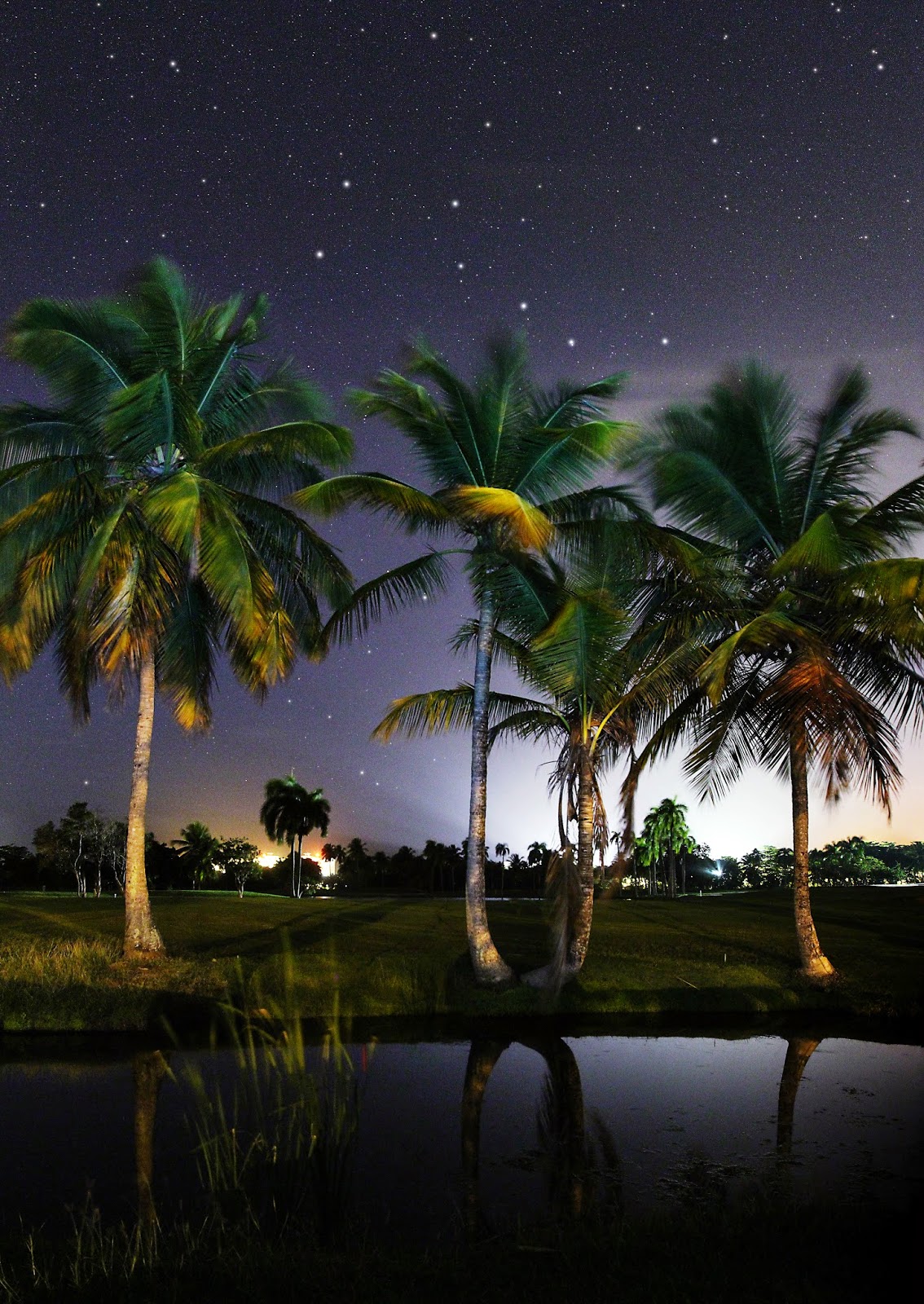
This image can be used as a practical astronomy question: “What is the latitude of the observer?” Palm trees and the low altitude of the Big Dipper provide strong clues that this photo was taken much closer to the equator than typical northern U.S. locations.

Palm trees and planet Jupiter in Puerto Rico night sky astrophotography
Palm trees and Jupiter in the Puerto Rico night sky

Canon EOS 60Da · EF 16–35mm f/2.8L II USM · 20 sec · ISO 3200 · f/4.5

Orion and Canis Major constellations above palm trees in Puerto Rico
Palm trees with Orion and Canis Major — Puerto Rico astrophotography

 Canon EOS 60Da, EF16-35mm f/2.8L II USM lens, 20 sec, ISO-3200, F4.5

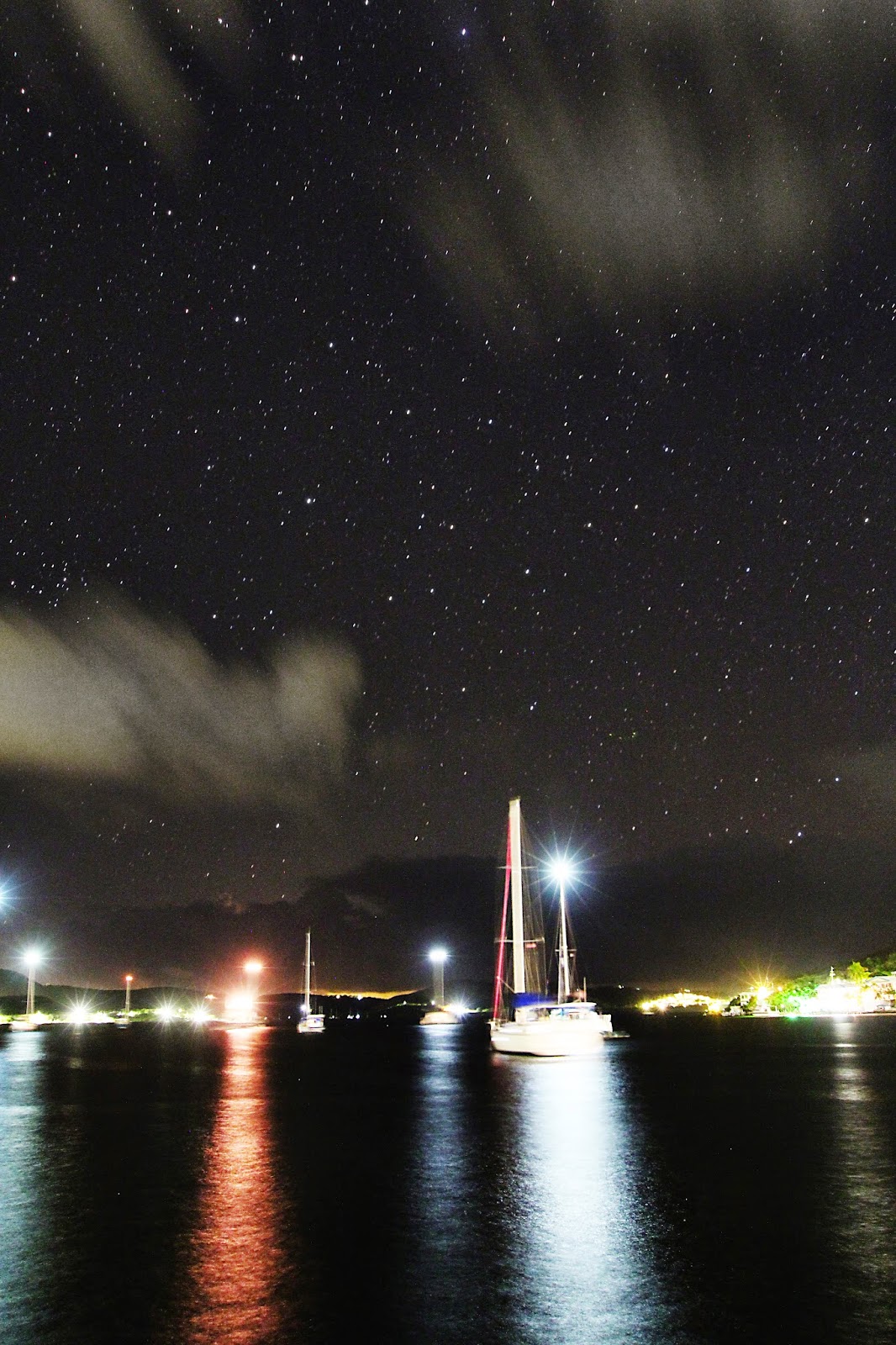
Yacht astrophotography at Culebra Island Puerto Rico showing long-exposure night sky and ocean motion
Yacht astrophotography at Culebra Island Puerto Rico with long exposure night sky
 Long exposure and waves gave such interesting yacht effect
Canon 60Da, EF16-35mm f/2.8L II USM lens, 30 sec, ISO-3200, F4

Near-equator view of the Big and Little Dippers in Puerto Rico nightscape astrophotography
Near Equator Big and Little Dippers Puerto Rico Nightscape Astrophotography

Canon 60Da, Wide Angle EF16-35mm f/2.8L II USM lens, 10 sec, ISO-6400, F2.8

Polaris North Star marked with laser pointer over golf course in Puerto Rico astrophotography
Northern Pole  Star - Polaris - Laser Pointer Puerto Rico Golf Course Astrophotography

 Canon 60Da, EF16-35mm f/2.8L II USM lens, 14 sec, ISO-3200, F6.3

Dark-sky nightscape from Culebra Island Puerto Rico showing stars over tropical landscape
Culebra Puerto Rico Night Sky
  Canon 60Da, EF16-35mm f/2.8L II USM lens, 30 sec, ISO-3200, F4

Advanced Astrophotography — Tracked Exposure

The final image below represents a different level of astrophotography. Unlike the previous nightscapes, this photograph was captured using a star tracker, allowing a much longer exposure and revealing faint nebulae invisible in short exposures.

Tracked wide-field astrophotography of Orion showing Barnard’s Loop and Winter Milky Way from Culebra Island Puerto Rico
Orion, Canis Major and Milky Way - iOptron SkyTracker  Astrophotography Puerto Rico

Barnard’s Loop is often one of the first emission nebulae successfully captured in tracked wide-field astrophotography, making it a natural milestone for beginners moving beyond nightscapes.

Canon EOS 60Da · EF 16–35mm f/2.8L II USM · iOptron SkyTracker
120 sec · ISO 3200 · f/4.0 · Culebra Island, Puerto Rico

At this exposure length, faint objects become visible, including Barnard’s Loop, the Great Orion Nebula (M42), Horsehead Nebula (IC 434), Witch Head Nebula (IC 2118), Rosette Nebula, and Seagull Nebula (IC 2177).

Winter Milky Way images are more challenging than summer Milky Way photography because the galactic center lies on the opposite side of the sky. Tracking with the iOptron SkyTracker made it possible to capture significantly more detail despite limited clear skies.

Related Astrophotography Posts

Saturday, February 28, 2015

Puerto Rico Radio-Telescope Arecibo Observatory

This post documents a daytime visit to the legendary Arecibo Observatory in Puerto Rico, when the 305-meter radio telescope was still fully operational and open to the public. While these are not night-sky images, Arecibo was one of the most important scientific instruments ever built for radio astronomy, planetary radar, and the study of the ionosphere.

For many amateur astronomers and astrophotographers, visiting Arecibo felt like a pilgrimage — standing beneath a structure that helped characterize asteroids, study pulsars, and expand our understanding of the universe using radio waves rather than visible light.

View of the Arecibo Radio Telescope reflector dish and suspended receiver platform photographed from the observation deck during daytime
View of the Arecibo Radio Telescope reflector and suspended receiver platform, photographed from the observation deck

Receiver platform of the Arecibo Radio Telescope photographed from the observation deck, showing the suspended feed structure above the reflector
Receiver platform of the Arecibo Radio Telescope, viewed from the observation deck

Flowers in the foreground with the Arecibo Observatory structures and the suspended receiver platform visible in the background, photographed from the observation deck
Flowers in the foreground with the Arecibo Observatory and its suspended receiver platform visible in the background

Diagram showing the anatomy of the Arecibo Radio Telescope including dish and suspended platform
Anatomy of the Arecibo Radio Telescope

Arecibo Observatory logo signage photographed at the visitor center
Arecibo Observatory Logo

Galaxy Shop gift store at Arecibo Observatory visitor center in Puerto Rico
Galaxy Shop

Arecibo Observatory visitor center building exterior in Puerto Rico (daytime)
Arecibo Observatory visitor center

Interior exhibits inside the Ángel Ramos Foundation visitor center at Arecibo Observatory
Angel Ramos Foundation Visitor Center inside

Additional exhibits inside the Arecibo Observatory visitor center in Puerto Rico
Observatory Visitor Center inside

Star planetarium at the Arecibo Observatory visitor center in Puerto Rico
Star planetarium

Milky Way model display inside the Arecibo Observatory visitor center
Milky Way Model
Astronomy poster displayed at the Arecibo Observatory visitor center in Puerto Rico
Poster

Flags displayed at the Arecibo Observatory site in Puerto Rico
Observatory Flags

Arecibo Observatory and Ángel Ramos Foundation visitor center
Arecibo observatory and Angel Ramos Foundation Visitor Center

Telephoto zoom view of the Arecibo Radio Telescope receiver platform photographed from the observation deck using a long focal length lens
Telephoto zoom of the Arecibo Radio Telescope receiver platform, captured from the observation deck


Anatomy diagram of the Arecibo Radio Telescope in the foreground with the suspended receiver platform visible in the background
Anatomy of the Arecibo Radio Telescope in the foreground, with the suspended receiver platform visible behind

Related Posts

Other Observatory Visits

In addition to Arecibo, I have visited and documented several major astronomical observatories across different regions. Each site reflects a distinct approach to exploring the universe, from optical telescopes to large-scale radio arrays.


Historical note:
All images in this post were captured while the Arecibo Observatory was fully active and intact. These photographs predate major damage from Hurricane Maria (2017) and the later structural failures in 2020, including the auxiliary cable break in August and the second cable break in November, which led to the telescope’s collapse on December 1, 2020.

Arecibo remains one of the most iconic sites in the history of astronomy. This post is preserved as a visual record of the observatory during its operational years.