blank'/>

Astrophotography banner

Showing posts with label Observatory. Show all posts

Tuesday, October 10, 2023

Magdalena Astronomy Club - Interpretation of time diffraction

 Can the future interacting with the past create the present?


Astronomer figurine at Magdalena Astronomical Lyceum near VLA, Magdalena New Mexico — astrophotography by astroval
Astronomer Figurine in Magdalena Astronomical Lyceum

In classic Newton mechanics answer is no. It is contradict the causality principle. But in quantum mechanics situation is much more complex. 

Just read article "Double-slit time diffraction at optical frequencies" which was published in Nature Physics April 03, 2023. Photons in future and past coming through Double split in time are creating diffraction in the present, and this is not theory - it is result of experiment!


Telescopes and astronomical tools at Magdalena Astronomical Club in Magdalena, New Mexico
Magdalena Astronomical Society_Astronomical Lyceum

I tried to explain it. First thinking about fantasy books which I read when was young. In this book people go to the past and after that return to the present and see that present was changed. Second thinking about retrocausality. It is opposite effect when the future changes the present. But interaction of the future and the past? 

Collection of vintage telescopes inside the Magdalena Astronomical Club, New Mexico — classic reflector and refractor designs preserved by the club’s technical curator.
Magdalena Astronomical Club

In the same time I thinking about Astronomical Club in Magdalena. And in some moment I got how to explain time diffraction. The future is The Karl G. Jansky Very Large Array (VLA), past is history of Magdalena city, near VLA, and current is the Astronomical club.

Another view inside the Magdalena Astronomical Club, showing vintage telescopes carefully arranged in the observatory room — a tribute to decades of amateur astronomy
Astronomical Lyceum

The VLA, Magdalena's history, and the Astronomical Club of Magdalena all illustrate how the future can interact with the past to create the present. 


Magdalena Astronomical Society

The VLA's cutting-edge technology builds upon the advancements of the past while paving the way for future discoveries. 

Magdalena Astronomical Tools

Magdalena Tools

Workshop inside the Magdalena Lyceum showing astronomical tools, mounts, and components used to build or repair telescopes and other observing equipment.
Make a telescope Magdalena Astronomical Tools

Magdalena's history shapes the present of the town and its people, and the Astronomical Club of Magdalena continues to appreciate and learn from the knowledge of the past while using modern technology to explore and understand the cosmos. 

Magdalena Lyceum

Inside the Magdalena Lyceum in New Mexico, showing a collection of vintage telescopes and astronomy instruments carefully arranged across the observatory room.
Telescopes in Magdalena Astronomical Club

Ultimately, the future and the past are two sides of the same coin, each influencing and shaping the present in unique and meaningful ways.

Telescope of Magdalena Astronomical Lyceum

Related Astrophotography Posts

Sunday, April 23, 2023

The Karl G. Jansky Very Large Array (VLA)


These photos from my travel trip to New Mexico Very Large Array. 

The Karl G. Jansky Very Large Array (VLA) is a radio astronomy observatory located in central New Mexico, USA.


Karl G. Jansky Very Large Array sign at night under the starry New Mexico sky, photographed by astroval.
The Karl G. Jansky Very Large Array (VLA) Sign at Night

The VLA was first proposed in the 1960s as a replacement for the older National Radio Astronomy Observatory (NRAO) antennas. Construction began in 1973, and the VLA was completed in 1980. The VLA consists of 28 dish antennas that can be arranged in different configurations to observe different parts of the sky.
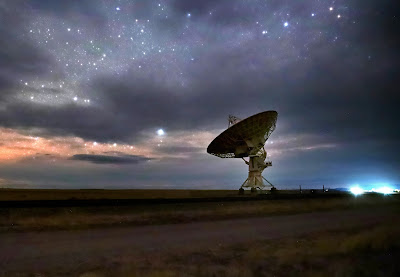

Radio telescope dish of the Very Large Array illuminated under clouds and stars in New Mexico night sky.
Radio Telescope at Night

The VLA is a powerful tool for radio astronomy, as it is capable of observing a wide range of celestial objects, including stars, galaxies, and black holes. Because the VLA observes in the radio frequency range, it can see through dust clouds and other obstructions that would be opaque to visible light telescopes. 
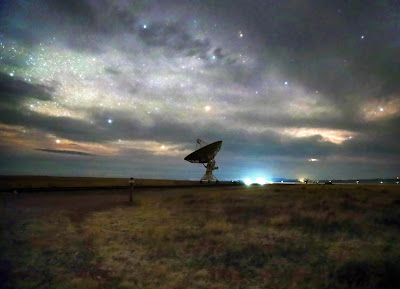
Very Large Array radio telescopes aligned across the desert landscape of New Mexico at night.
VLA Radio Telescope at Night

One of the most famous scientific discoveries made using the VLA was the confirmation of the existence of black holes. In 1974, astronomers using the VLA observed a radio source called Cygnus X-1, which was suspected to be a black hole. By observing the orbital motion of a companion star to Cygnus X-1, the astronomers were able to confirm that it was indeed a black hole.
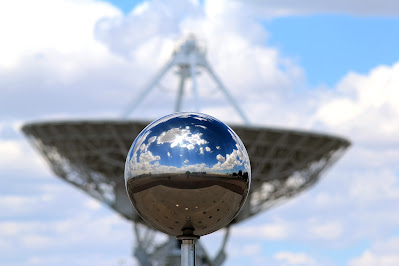
Creative crystal ball reflection of the Very Large Array antennas and Milky Way by astroval.
Sky Reflection - Crystal Ball

In addition to the discovery of black holes, the VLA has made many other important scientific discoveries. For example, in 1998, astronomers using the VLA discovered the first radio-emitting magnetar, a type of neutron star with an extremely powerful magnetic field. The VLA has also been used to study the properties of interstellar gas and dust, as well as the formation of stars and galaxies.
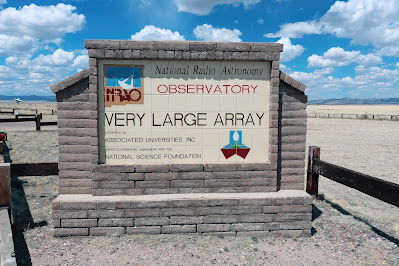

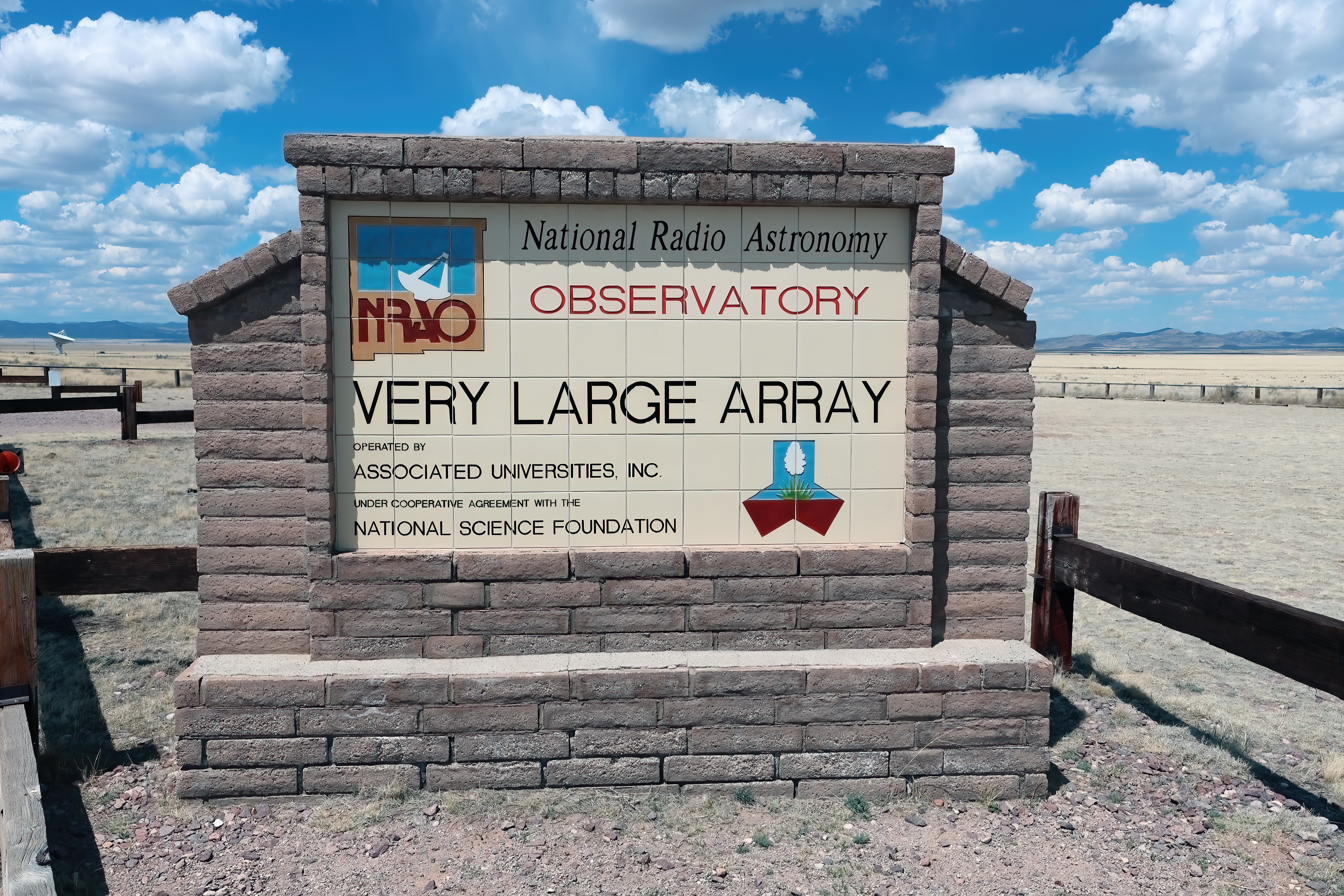
Official sign of the Karl G. Jansky Very Large Array near the entrance of the observatory in New Mexico, photographed during the day.
VLA Sign

The Karl G. Jansky Very Large Array (VLA) was also featured prominently in the 1997 science fiction film "Contact", based on the novel by Carl Sagan. The film tells the story of a scientist named Ellie Arroway, played by Jodie Foster, who uses the VLA to search for extraterrestrial intelligence.

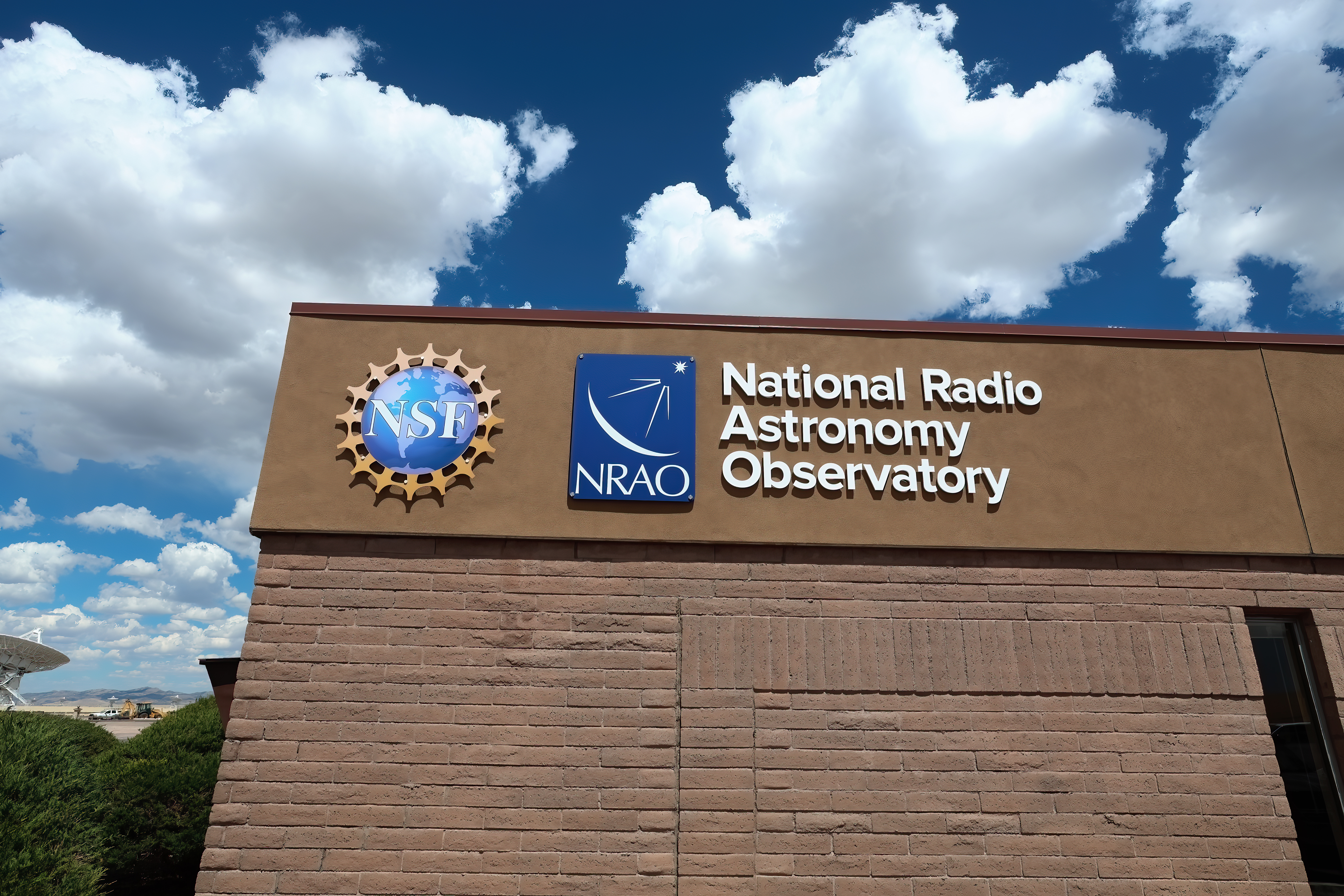
National Radio Astronomy Observatory building at the Karl G. Jansky Very Large Array site in New Mexico, photographed during the day.
NRAO

In the film, Arroway and her team use the VLA to search for signals from other civilizations in the universe. The VLA's ability to detect faint radio signals from distant objects is crucial to their search, as they believe that other intelligent beings may use radio waves to communicate with one another.
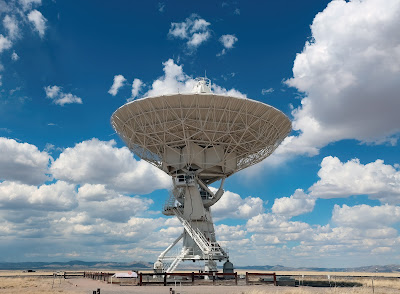
Single radio telescope dish at the Karl G. Jansky Very Large Array in New Mexico, part of the National Radio Astronomy Observatory, photographed during the day.
Radio Telescope

"Contact" is a science fiction film that features the Karl G. Jansky Very Large Array as a key element in its plot. Although the film's depiction of the VLA is largely fictional, it did raise awareness of the observatory and its capabilities among the general public. The VLA remains a powerful tool for scientific research, and its ongoing use by astronomers and other scientists continues to expand our understanding of the universe.

Line of four radio telescope dishes at the Karl G. Jansky Very Large Array in New Mexico, part of the National Radio Astronomy Observatory, photographed during the day.
VLA

I have only one day and night to make photos. Weather was not perfect. But I thing clouds give some drama to these photos.

Related Astrophotography Posts

Explore more observatories and astrophotography projects from my travels around the world:

Saturday, October 15, 2022

Joshua Tree National Park Night Sky Festival 2022

 There are night photos from Joshua Tree National Park Night Sky Festival 2022.

Joshua Tree National Park Night Sky Festival Observatory

Joshua Tree National Park Night Sky Festival 1 

Joshua Tree National Park Night Sky Festival 2

Joshua Tree National Park Night Sky Festival 3

Joshua Tree National Park Night Sky Festival 4

Joshua Tree National Park Night Sky Festival 5

Joshua Tree National Park Night Sky Festival 6

Joshua Tree National Park Night Sky Festival 7

Joshua Tree National Park Night Sky Festival 8

Joshua Tree National Park Night Sky Festival 9

Joshua Tree National Park Night Sky Festival 10

Joshua Tree National Park Night Sky Festival 11

Joshua Tree National Park Night Sky Festival 12

Joshua Tree National Park Night Sky Festival 13

Joshua Tree National Park Night Sky Festival 14

Joshua Tree National Park Night Sky Festival 15

Joshua Tree National Park Night Sky Festival 16

Joshua Tree National Park Night Sky Festival 17


Thursday, October 13, 2022

Sky's The Limit Observatory

Here are some photos of Sky's The Limit Observatory and Nature Center from my trip to Joshua Tree National Park. This observatory is located just outside the park, between the north entrance and the town of Twentynine Palms, California.

Sky's The Limit is a well-known place for astronomy outreach in the Joshua Tree area. It is a nice place to visit both during the day and at night, with observatory domes, telescopes, and an open desert setting that fits very well with the spirit of Southern California astronomy.

Because Joshua Tree is famous for its dark skies, this observatory is also a natural stop for people interested in stargazing, amateur astronomy, and astrophotography. Even the surroundings already create the feeling that you are entering a place dedicated to the night sky.

Sky's The Limit Observatory and Nature Center near Joshua Tree National Park
Sky's The Limit Observatory and Nature Center


Sky's The Limit Observatory and Nature Center at night in Twentynine Palms California
Sky's The Limit Observatory and Nature Center at Night


Observatory dome at Sky's The Limit Observatory near Joshua Tree National Park
Sky's The Limit Observatory Dome

At night the observatory becomes even more atmospheric, with the buildings and domes standing under the desert sky not far from Joshua Tree National Park.

Night sky above Sky's The Limit Observatory near Joshua Tree National Park
Night Sky - Sky's The Limit Observatory

Sky's The Limit Observatory in Twentynine Palms California
Sky’s the Limit Observatory in 29 Palms

Sky's The Limit Observatory near Joshua Tree National Park in California
Sky's The Limit Observatory near Joshua Tree National Park

Sky's The Limit Observatory at night near Joshua Tree National Park
Sky's The Limit Observatory at night

This visit to Sky's The Limit Observatory was also part of my broader astrophotography trip to Joshua Tree National Park. It can also be compared with several other observatories and astronomy centers that I photographed in different parts of the world.

Related Joshua Tree Astrophotography Posts

Related Observatory and Astronomy Center Posts

Wednesday, September 30, 2020

Cherry Springs State Park Pennsylvania Astrophotography

Located in north-central Pennsylvania at an elevation of about 2,300 ft (701 m), Cherry Springs State Park is one of the darkest places on the entire U.S. East Coast. The park is an officially recognized International Dark Sky Park and is famous among astronomers and astrophotographers for its pristine, high-altitude skies and excellent 360-degree horizon views.

The Milky Way Over the Observatory Domes

In the foreground you can see two astronomical domes, the distant forest line, and a fun set of signs reading “Galaxy” – “Slow Down” – “No Dust”. Above the scene, the Milky Way rises brightly across the sky.

Milky Way over two observatory domes at Cherry Springs State Park Pennsylvania with Galaxy Slow Down No Dust sign
Cherry Springs State Park Pennsylvania Astrophotography - Galaxy - Slow down - No dust

Camera & Lens

  • Canon EOS 60Da (modified for astrophotography)
  • Canon EF 16–35mm f/2.8L II USM

Exposure Details

  • ISO 20,000
  • 15 sec exposure
  • f/2.8

Processing

Processed using Adobe Camera Raw, Photoshop, Topaz Denoise AI and Topaz Sharpen AI to reduce noise, enhance star clarity, and balance the color of the Milky Way.

About Cherry Springs: Why It’s Special

Cherry Springs State Park is considered one of the top stargazing sites in the eastern United States. Its remote location and high elevation mean exceptionally dark skies, often reaching Bortle Class 2. On moonless nights, the Milky Way is easily visible to the naked eye from horizon to horizon.

  • Very low light pollution
  • Dedicated astronomer field
  • Restricted vehicle movement after dark
  • No white lights allowed
  • Excellent southern horizon for Milky Way imaging

From NYC, the drive takes approximately five hours, leading deep into Pennsylvania forest land. When you arrive at night, the darkness feels almost unreal — perfect for astrophotography.

Daytime Photos from the Park

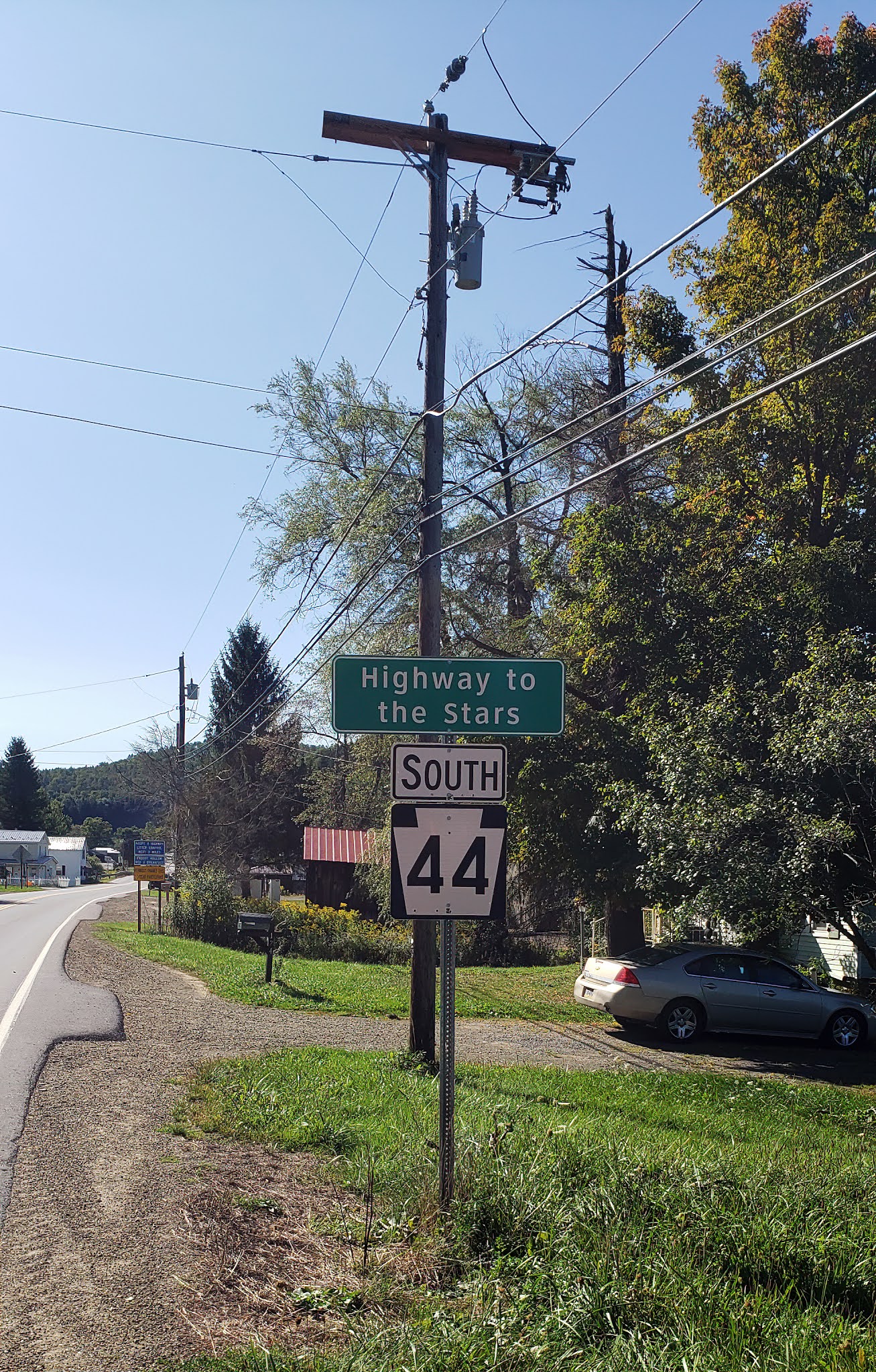
The following images were taken during the day to show how the park looks in normal light. This area includes the observatory domes, astronomer pads, fields, and surrounding forests. Cherry Springs has many fun details visible only in daylight — including the “Highway to the Stars” road sign near South 44, reminding visitors that they are entering one of the darkest and most famous stargazing locations in the eastern United States.


Astronomer area and domes at Cherry Springs State Park
Domes - Cherry Springs State Park, Pennsylvania

Astronomy field at Cherry Springs State Park Pennsylvania
Sign - Cherry Springs State Park

Dark Sky Fund Board information sign with logo at Cherry Springs State Park Pennsylvania
Dark Sky Fund

Stargazer's Delight informational sign at Cherry Springs State Park with astronomical images and text
Stargazer's Delight

Through an Astronomer's Eyes informational sign at Cherry Springs State Park showing astronomy diagrams and explanations
Through an Astronomer's Eyes

Road at Cherry Springs State Park with South 44 road sign and Highway to the Stars sign on pole
Highway to the Stars

Astro Haven Dome with nearby tents, parking area, and forest at Cherry Springs State Park Pennsylvania
Astro Haven Dome

Directional sign at Cherry Springs State Park showing Astronomers Overnight Area, Public Program Parking, Short Term Stargazing Parking, and Campground
Astronomers overnight area

Cherry Springs remains one of my favorite dark-sky locations in the eastern United States. The combination of quiet forest surroundings, dedicated observatory domes, and extremely dark skies makes it a dream destination for night-sky photographers.

Visiting Tips

  • Best time for Milky Way: April–September (new moon weekends are best).
  • Bring red lights only: white light is prohibited.
  • Warm clothing: nights get cold even in summer.
  • Arrive before sunset: headlights are not allowed to enter the astronomy field after dark.
  • Reserve ahead: astronomer field can fill up on holidays or special events.

Related Posts