blank'/>

Astrophotography banner

Showing posts sorted by date for query Milky Way. Sort by relevance Show all posts

Wednesday, April 15, 2026

Camel on a Dune Under the Starry Sahara Sky – Merzouga, Morocco

This photo was taken at night in the Sahara Desert near Merzouga, Morocco. A camel and its keeper are standing on the top of a sand dune under a clear, star-filled sky. Above the camel and its keeper, both the Big Dipper and the Little Dipper can be recognized in the Sahara sky.

Camel and keeper on top of a sand dune in the Sahara Desert at night under the Big Dipper and Little Dipper in Merzouga, Morocco
Camel on a Dune Under the Starry Sahara Sky – Merzouga, Morocco

One of the most interesting details in this image is the light. On the far side of the dune, much lower and outside the frame, there was a desert camp. The camp itself is not visible, but even this relatively weak light was enough to illuminate the camel and its keeper. That subtle light illuminated the camel and its keeper just enough to create a striking silhouette against the dark dune and the night sky.

This combination of desert landscape, human presence, and recognizable stars made the moment especially memorable. The camel and keeper standing on the crest of the dune give the scene a timeless feeling, while the starry sky above connects the quiet Sahara night with the wider universe.

This image was made as a panorama of 3 photos using a Canon EOS Ra camera with a Canon EF 16-35mm f/2.8L II USM lens at 16mm. Exposure settings were f/2.8, ISO 12800, 15 seconds. The photo was taken on April 7, 2026.

Finding Polaris in the Sahara Sky

This photo also shows a classic way to identify Polaris, the North Star. The two outer stars of the bowl of the Big Dipper, known as the pointer stars, can be used to find Polaris. If you follow the line from these stars outward, it leads to Polaris, which marks the end of the handle of the Little Dipper.

Even in a desert landscape far from city lights, this simple star pattern remains one of the easiest and most famous ways to navigate the night sky.

Annotated night sky over the Sahara Desert in Merzouga, Morocco, showing the Big Dipper, Little Dipper, and Polaris above a camel and keeper on a dune
Annotated Sahara night sky showing the Big Dipper, Little Dipper, and Polaris above a camel and its keeper on a dune in Merzouga, Morocco.

Related Big Dipper and Africa Astrophotography Posts

This Sahara Desert image connects both with my Big Dipper astrophotography collection and with other Africa night sky photos from my travels.

Monday, January 26, 2026

Tanzania Cloudy Astrophotography

These are several astrophotography images from Tanzania that did not make it into my earlier post featuring the Rainbow Milky Way. That previous post focused on rare color and clarity, while these images were captured during a much cloudier night.

Although clouds often end an astrophotography session, in this case they added atmosphere and depth to the scene. With no Moon in the sky, the clouds appear as dark silhouettes against the star field and the Milky Way, creating a very different mood compared to clear-sky images.

All photos were taken at Nyikani Migration Camp, Tanzania on September 21.

Camera: Canon EOS Ra
Lens: Canon EF 16–35mm f/2.8L II USM
Exposure: f/3.2 · ISO 6400 · 15 sec
Technique: Panorama (4 images)

Milky Way under two safari tents at Nyikani Migration Camp during a cloudy, moonless night in Tanzania
Two safari tents frame the central part of the Milky Way. With no Moon present, clouds appear as dark shapes cutting through the star field.

In the first image, two safari tents are visible in the foreground, with the central part of the Milky Way positioned under them. The sky was completely moonless, allowing the clouds to show up as dark structures against the stars rather than reflecting light.

Milky Way rising above a safari tent with trees and clouds at Nyikani Migration Camp, Tanzania
A single safari tent under the Milky Way, surrounded by trees and passing clouds.

In the second image, the Milky Way rises directly above a safari tent, with a green tree visible in the foreground. Both images were taken as close to the camp as possible, keeping the scene simple and grounded in the immediate surroundings.

These photographs are much simpler than the Rainbow Milky Way panorama, but they document another side of night photography in Tanzania — where clouds, darkness, and proximity to the landscape all play a role in shaping the final image.

Related Tanzania Astrophotography

Saturday, December 13, 2025

Drive Safely Between the Milky Way and the Haystack

This is an old photograph from my archive — one that I shared years ago on Flickr and Facebook, but somehow never published on my blog. Probably I was simply too busy at the time. Yet I always liked this image. It belongs to my small but meaningful series of philosophical, minimalistic astrophotography.

The photograph was taken in White Lake, Sullivan County, in the Catskill Mountains of New York State. It is a very simple, single exposure image — but sometimes simplicity tells the strongest story.

Canon EOS 60Da, EF16–35mm f/2.8L II USM
ISO 6400 · f/2.8 · 15 seconds

Drive Safely Between the Milky Way and the Haystack minimalist astrophotography Catskill Mountains New York
Drive Safely Between the Milky Way and the Haystack — Minimalist Nightscape, Catskills

With a 15-second exposure, the headlights of a passing car turn into a glowing light path. This streak of light creates an illusion of motion beyond normal driving — it looks like a jump drive, hyperdrive, warp jump, or even an interstellar teleporter.

In the foreground you can see the Haystack, partially blocking the light trail. That small interruption adds depth and makes the scene feel truly three-dimensional. Below it all, near the horizon, the bright central region of the Milky Way quietly glows.

Looking at this image, I can’t help but think: “Drive safely between the Milky Way and the Haystack.”

Sometimes I imagine this photograph as a road sign — something you might see near an observatory or astronomy club. A reminder that even an ordinary night drive can pass through something cosmic.

This image continues my series of minimalistic astrophotography ideas started years ago, including:

Interestingly, both this image and the photograph from Unintentional Camera Movement Astrophotography often remind me of science-fiction films — especially Back to the Future and Star Wars.

Sometimes astrophotography is not just about stars, but about motion, imagination, and the thin line between everyday reality and the universe beyond.

Sunday, November 23, 2025

Argentina Astrophotography – El Chaltén Night Sky

In 2024 I traveled to Argentina, and one of the most unforgettable experiences of the trip was a night hike near El Chaltén. The region is famous for its dramatic mountains, glaciers, and hiking trails—but it also offers incredibly dark skies. This part of Patagonia is far from large cities, giving you a truly pristine view of the southern hemisphere’s night sky.

This was my first time photographing the sky from Argentina, and I was immediately amazed at how different the stars looked compared to the northern hemisphere. The southern sky reveals Crux (the Southern Cross), the Large and Small Magellanic Clouds, and the bright arc of the Milky Way rising over the mountain silhouettes. These are objects we cannot see at all from most of North America. Patagonia's exceptionally dark skies make these features stand out even more in long-exposure night photography.

Milky Way Astrophotography panorama over El Chaltén, Argentina, captured with Canon EOS Ra from Patagonia’s dark sky.
Milky Way rising above the mountains of El Chaltén, Argentina. This 3-image panorama was captured during my night hike in Patagonia using the Canon EOS Ra. The southern sky was extremely dark, revealing the Milky Way arc, the Southern Cross, and faint Magellanic Clouds above the silhouette of the Andes.

Wide Milky Way panorama above the mountains of El Chaltén, Argentina, photographed with Canon EOS Ra.
Wide 4-image Milky Way panorama photographed near El Chaltén, Argentina. Taken with the Canon EOS Ra under pristine Patagonia skies, the image shows the Milky Way stretching across the horizon with beautiful detail in the galactic structure. Soft background glow from distant mountain huts adds depth to the landscape.

Equipment and Camera Settings

All images were taken with:

  • Canon EOS Ra (mirrorless astrophotography camera)
  • Canon EF 16–35mm f/2.8L II USM wide-angle lens

Image Set 1:
Canon EOS Ra, EF 16–35mm f/2.8L II USM, f/2.8; ISO 12800, 5 sec exposure
Panorama of 3 images — captured on January 12, 2024 at 11 PM.

Image Set 2:
Canon EOS Ra, EF 16–35mm f/2.8L II USM, f/2.8; ISO 12800, 10 sec exposure
Panorama of 4 images — captured on January 13, 2024.

First Results of the Night Hike

These panoramas are the first results from my night hike. The mountains around El Chaltén create beautiful silhouettes, and in some shots you can see a faint background glow from distant mountain huts. Even with the glow, the sky remained extremely dark—perfect for capturing detail in the Milky Way.

The Large Magellanic Cloud (LMC) and Small Magellanic Cloud (SMC) were easily visible to the naked eye. Seeing them for the first time is an unforgettable moment for any astrophotographer. They look like two small detached “clouds,” but they are actually dwarf galaxies orbiting our Milky Way.

A New Sky, A New Experience

Photographing the southern sky feels like discovering a different universe. The familiar northern constellations vanish, replaced with stars and structures I had never seen before. Crux, the Southern Cross, stands high above the horizon and serves as a perfect anchor for night panoramas.

Location: El Chaltén, Argentina • Patagonia
Year: 2024 Travel (images processed in 2025)

Related Astrophotography Posts

Sunday, November 2, 2025

Why the Equatorial Sky Glows More Red — Tanzania & Galápagos Astrophotography Experience

During my last trip to Tanzania, I spent several nights photographing the Milky Way with strong equatorial red airglow under perfectly dark skies near the magnetic equator. What caught my attention almost immediately was something unexpected — on photos the sky looked unusually reddish.

Milky Way with equatorial red airglow over Nyikani Migration Camp in Tanzania, photographed near the magnetic equator.

Milky Way with Equatorial red airglow over Nyikani Migration Camp, Tanzania, captured with Canon EOS Ra and EF200mm f/2.8L II lens, showing red equatorial airglow.
Canon EOS Ra, Canon EF200mm f/2.8L II USM Lens, f/3.2; ISO 12800, 15 sec. one photo, Panorama 21 images, combine in Photoshop, September 22, 2025, Nyikani Migration Camp, Tanzania - Equatorial red airglow

       At first, I thought it was just a trick of the weather.

      But the reddish tone wasn’t just a one-night surprise — it appeared the second night, and again the third night, no matter where I set up my tripod.

Nightscape of the Milky Way with Equatorial red airglow  above Signature Serengeti Camp, Tanzania, 21-image panorama by Canon EOS Ra showing reddish tropical airglow.
Canon EOS Ra, Canon EF200mm f/2.8L II USM Lens, f/3.2; ISO 20000, 20 sec. one photo, Panorama 21 images, combine in Photoshop, September 23, 2025, Signature Serengeti Camp, Tanzania - Equatorial red airglow

Milky Way with Equatorial red airglow over Baobab trees in Tarangire National Park, Tanzania, 21-image astrophotography panorama captured with Canon EOS Ra.
Canon EOS Ra, Canon EF200mm f/2.8L II USM Lens, f/3.2; ISO 25600, 15 sec. one photo, Panorama 21 images, combine in Photoshop, September 26, 2025, Tarangire National Park, Tanzania - Equatorial red airglow

      Later, I went back through some of my older photos taken a few years earlier in the Galápagos Islands, and there it was again — that same faint red glow in the sky background.

Milky Way and Equatorial red airglow over Puerto Villamil, Isabela Island, Galápagos, photographed with Canon EOS 60Da and EF16–35mm f/2.8L II lens, revealing faint red equatorial airglow.
Canon EOS 60Da, EF16-35mm f/2.8L II USM, 16.0 sec; f/2.8; ISO 6400, about 40 photos, combine in Photoshop, Feb 23, 2018, Puerto Villamil, Isabela Island, Galapagos, Ecuador - Equatorial red airglow

    Four photos, two locations, years apart… and the same pattern. All were taken under dark, moonless skies far from city lights. The red glow wasn’t from pollution — it was coming from the atmosphere itself.

      So I started digging to find out why.

Why It’s Redder Near the Equator

      After reading through scientific papers and observing reports, I found that this red dominance near the equator isn’t a coincidence — it’s a well-known pattern. In scientific literature, some of these large-scale equatorial red airglow patterns are described as intertropical arcs, a technical term for 630 nm nightglow structures seen near the geomagnetic equator.

      Near the magnetic equator, the upper atmosphere gets more direct sunlight and stronger ultraviolet radiation from the Sun. That creates more ionization and more energetic electrons high above Earth. When those electrons recombine with oxygen atoms at night, they emit bright red 630 nm light.

      Meanwhile, the lower green-emitting layer is denser and warmer in tropical regions. Collisions there often “quench” the green light before it can shine. So while both colors exist everywhere, the red layer wins near the equator — especially during periods of strong solar activity like the one we’re in now.


Illustration showing airglow color ratio between green and red emissions versus latitude, highlighting stronger red near the equator.
Toy model: Airglow “color” vs latitude (Green 557.7 nm / Red 630.0 nm)

A Simple Way to Imagine It

Think of it like two glowing shells around Earth:

  • A lower green shell — thicker air, more collisions, so light is often quenched
  • A higher red shell — thinner air, stronger ionization, shining freely into space.

At higher latitudes, the green layer shines more clearly. Near the equator, the red shell becomes brighter and overshadows it. My camera was basically looking through more of that red upper layer, capturing a stronger crimson glow.

The Beauty of Accidental Science


I didn’t set out to study airglow — I was just chasing the Milky Way. But sometimes astrophotography turns into a kind of quiet citizen science. My four “anecdotal” photos ended up showing a real global trend that scientists have been measuring for decades. It is also worth noting that the photos were taken with astronomy-oriented cameras — the Canon EOS Ra in Tanzania and the Canon EOS 60Da in the Galápagos — whose enhanced sensitivity to deep red wavelengths may have made this faint equatorial airglow easier to capture.

It’s a reminder that even casual night photographers can notice patterns that connect directly to planetary physics. Next time you shoot the night sky near the tropics, look closely when you process your images. If you see a faint red haze in the background, that’s not light pollution or a white-balance mistake — it’s Earth’s upper atmosphere glowing.

Final Thoughts


Standing under the African night with the Milky Way overhead and the warm breeze on my face, I realized that the sky’s color is not fixed. Even in darkness, our planet shines with its own quiet heartbeat — a breath of red light from hundreds of kilometers above.

The next time you photograph a dark sky, remember: sometimes your camera captures more than stars — it records the living atmosphere of the Earth itself.


Related Astrophotography Posts


Saturday, October 4, 2025

Rainbow of the Milky Way and the Eternal Baobab — Tarangire, Tanzania

On the midnight of September 26, 2025, under the deep African sky, I captured one of the most surreal moments of light and life. The photograph — a 21-image panorama taken with my Canon EOS Ra and Canon EF 200 mm f/2.8L II USM lens (f/3.2, ISO 25 600, 15 s exposure) — reveals the Milky Way arcing like a celestial rainbow above a solitary baobab tree in Tarangire National Park, Tanzania.

Rainbow of the Milky Way above a Baobab tree in Tarangire National Park, Tanzania — long-exposure Africa astrophotography captured with Canon EOS Ra.
Rainbow of the Milky Way and the Eternal Baobab - Tarangire National Park, Tanzania

This is a single-night image, stitched in Photoshop, but it carries the weight of millennia — both cosmic and earthly.


The Baobab: The Tree of Life

At the center of the frame stands the baobab (Adansonia digitata), often called the Tree of Life. Native to the dry savannas of sub-Saharan Africa, this extraordinary species grows in scattered populations across Tanzania, Madagascar, and parts of the Sahel. Baobabs can live for over 2 000 years — some carbon-dated specimens have reached 2 500 to 3 000 years old — silently witnessing the passing of generations, civilizations, and climates.

Baobab tree in Tarangire National Park, Tanzania, photographed during the day — massive trunk of the Tree of Life under clear African sky.
Baobab

Their immense trunks, often more than 10 meters in diameter, are actually natural reservoirs; a single tree can hold up to 120 000 liters of water within its fibrous tissue. In the dry season, elephants and baboons are sometimes seen peeling their bark to reach the moisture inside.

In African folklore, the baobab is a sacred symbol — a meeting of heaven and earth. Its branches, reaching skyward like roots, gave rise to legends that the gods planted it upside-down. Standing beside one beneath the Milky Way, the resemblance to a cosmic silhouette feels almost intentional.


Tarangire: The Quiet Heart of the Savanna

Located just south of the equator in northern Tanzania, Tarangire National Park is a sanctuary of vast plains, ancient river valleys, and herds of elephants. Its skies are among the clearest and darkest in East Africa, especially during the dry season from June to October.

That night, around midnight, the air was perfectly still. The southern Milky Way rose high overhead, and the galactic core shimmered in a curtain of color rarely visible to the naked eye.


The Airglow

The subtle green, red, and orange tones in the photo are not from city lights — they are natural airglow, an atmospheric phenomenon that occurs when molecules in the upper atmosphere (about 85–100 km up) emit faint light after being energized by the Sun during the day.

Contrary to popular belief, strong airglow is not limited to the poles; it is often most intense near the equator, where the upper atmosphere experiences greater gravity-wave activity and chemical recombination. Near-equatorial latitudes like Tarangire (~4° S) often produce beautifully structured bands of red (from oxygen at ~250 km) and green (from oxygen at ~95 km) that shimmer across the night sky — invisible to human eyes but captured vividly in long-exposure astrophotography.

What you see above the baobab, therefore, is not light pollution but the Earth itself glowing, whispering its quiet luminescence into the darkness.


A Meeting of Earth and Sky

This image is a meeting of contrasts: an ancient tree rooted in the soil of Africa, and a galaxy 100 000 light-years across suspended above it. Between them, a living, breathing layer of atmosphere paints the bridge — the airglow, the breath of our planet.


Under the Milky Way in Tarangire National Park, Tanzania — Baobab tree beneath the galactic core captured during Africa astrophotography expedition.
Under the Milky Way: A Night in Tarangire

Every color in the image tells a story:

  • Amber and red: oxygen recombining high above the equator.
  • Soft green: the pulse of Earth’s upper atmosphere.
  • Silver stars: the spiral arm of the Milky Way.
  • Dark silhouette: a 1 000-year-old baobab tree watching the cosmos turn.

In that moment, Tarangire was not just a national park — it was a reminder that the planet itself participates in the night sky.


Technical Notes

  • Camera: Canon EOS Ra (modified for astrophotography)
  • Lens: Canon EF 200 mm f/2.8L II USM
  • Settings: f/3.2 · 15 s · ISO 25 600
  • Panorama: 21 frames combined in Adobe Photoshop
  • Date: September 26, 2025
  • Location: Tarangire National Park, Tanzania (~4° S latitude)


Reflection

When I look at this photograph, I see time itself — the timeless patience of the baobab and the ceaseless motion of the stars. Both are survivors: one through endurance, the other through orbit.

Under that rainbow Milky Way, I realized that the Earth doesn’t just reflect the universe — it participates in it. The light that touched the baobab that night had traveled for tens of thousands of years, only to meet the glow of our own atmosphere.

Related Astrophotography Posts

Thursday, October 10, 2024

The Milky Way Over the Sailing Stone: A Night Under the Stars at Racetrack Playa, Death Valley National Park, California

Racetrack Playa is a place of natural intrigue. Situated in the heart of Death Valley, this dry, cracked lake bed is renowned for its "sailing stones" — large rocks that mysteriously move across the playa, leaving long tracks behind them. For decades, these stones puzzled scientists and visitors alike, as no one could quite figure out how these hefty rocks glided across the desert floor. It wasn’t until recently that a rare combination of ice, water, and wind was identified as the culprit behind their movement. 

The Milky Way over the sailing stones at Racetrack Playa, Death Valley National Park, California — night panorama astrophotography captured with Canon EOS Ra.
The Milky Way Over the Sailing Stones of Death Valley, California

Panorama 27 photos, Canon EOS Ra, EF16-35mm f/2.8L II USM Lens, f/2.8, ISO-25600, 20 seconds each photo.

When night falls at Racetrack Playa, another marvel unfolds overhead. With its location in one of the darkest national parks in the U.S., the sky above Death Valley becomes a portal to the universe. The absence of light pollution allows for one of the most pristine views of the Milky Way, an ocean of stars arching across the sky, giving photographers an ideal canvas for astrophotography.

One interesting detail in this panorama is the orientation of both the sky and the sailing stones. Near the horizon you can recognize the Big Dipper (Ursa Major) in a low position, while the Little Dipper (Ursa Minor) is also visible, with Polaris (the North Star) marking the direction of true north.

At this low altitude, the familiar shape of the Big Dipper appears more flattened than usual. One of its stars, Phecda, is not clearly visible, but the remaining main stars are still recognizable, allowing the asterism to be identified.

Racetrack Playa is located at a latitude where the Big Dipper is circumpolar, meaning it can be seen throughout the entire year. As the night progresses, it slowly rotates around Polaris, changing its position while always remaining above the horizon.

The movement of the stones in the foreground adds another layer of interest. The main sailing stone in the center shows a trail roughly aligned with the north–south direction, appearing to move from the direction of Polaris toward the observer. However, a second stone on the right side of the frame reveals a different trajectory, with its path running almost perpendicular to the main stone’s trail.

This variation highlights the complex and delicate conditions behind the sailing stones phenomenon. Their motion depends on a rare combination of thin ice sheets, shallow water, and shifting wind, allowing different stones to move at different times and in different directions, creating a network of intersecting trails.

Together, the scene presents a striking contrast: the sky above follows predictable celestial motion around Polaris, while the desert floor records irregular and transient movement. It is a rare moment where celestial order and natural variability can be observed in a single frame.

Sailing stone and its trail on Racetrack Playa, Death Valley National Park, under the Milky Way with Big Dipper and Small Dipper visible — night panorama astrophotography captured with Canon EOS Ra.
A close-up panorama of a solitary sailing stone and its long trail beneath the Milky Way and the Dippers.

Standing in the silence of Racetrack Playa under the brilliant Milky Way, one feels both humbled and uplifted. The ancient stones, moved over time by forces unseen, seem like they are part of a larger cosmic ballet, just as the stars above trace their eternal paths through space. In that quiet desert night, there is a profound sense of stillness, yet the sky and stones speak of movement across millennia.

Related Astrophotography Posts

Sunday, November 12, 2023

Alaska Astrophotography - Cosmic Symphony

Alaska, the "Last Frontier", is renowned for its pristine wilderness, vast landscapes, and breathtaking night skies. In August, when the days are still long but the nights begin to reveal their celestial wonders, I embarked on a photographic journey. This photo was done about midnight during remarkable night in Alaska, where the Milky Way, the Big and Little Dipper, Cassiopeia, and the Andromeda Galaxy took center stage amidst the backdrop of a tranquil forest and towering mountains.


Milky Way, Big and Little Dipper, Cassiopeia, and Andromeda Galaxy above Alaska’s forest and mountains — astrophotography by astroval using Canon EOS Ra.
Alaska Astrophotography - Milky Way, Big and Little Dipper, Cassiopeia and Andromeda Galaxy

Under the captivating beauty of the Milky Way, with a glacier river  winding through the mountains and a mysterious boat on its shores, will forever remain etched in my memory. It is a testament to the awe-inspiring landscapes that Alaska offers to those willing to venture into its remote corners. The photograph serves as a reminder of the incredible beauty that can be found in nature and the magic that can unfold on a single night in this pristine wilderness.


Milky Way over Alaska with a boat parked near a river and attached to a travel trailer car — night landscape astrophotography by astroval capturing the harmony of wilderness and starlight.
Alaska Travel Night Landscape Astrophotography


The photograph stands as a visual symphony, combining Earth's terrestrial wonders with the infinite cosmos, creating a breathtaking portrayal of the universe's grandeur.

Milky Way over Alaska highlighting Cygnus, Lyra, and Aquila constellations captured with Canon EOS Ra and EF16-35mm f/2.8L II USM.
Alaska Astrophotography Milky Way Cygnus Lira Aquila Constellations

Canon EOS Ra, EF16-35mm f/2.8L II USM Lens, f/2.8

Related Astrophotography Posts


Sunday, April 23, 2023

The Karl G. Jansky Very Large Array (VLA)


These photos from my travel trip to New Mexico Very Large Array. 

The Karl G. Jansky Very Large Array (VLA) is a radio astronomy observatory located in central New Mexico, USA.


Karl G. Jansky Very Large Array sign at night under the starry New Mexico sky, photographed by astroval.
The Karl G. Jansky Very Large Array (VLA) Sign at Night

The VLA was first proposed in the 1960s as a replacement for the older National Radio Astronomy Observatory (NRAO) antennas. Construction began in 1973, and the VLA was completed in 1980. The VLA consists of 28 dish antennas that can be arranged in different configurations to observe different parts of the sky.


Radio telescope dish of the Very Large Array illuminated under clouds and stars in New Mexico night sky.
Radio Telescope at Night

The VLA is a powerful tool for radio astronomy, as it is capable of observing a wide range of celestial objects, including stars, galaxies, and black holes. Because the VLA observes in the radio frequency range, it can see through dust clouds and other obstructions that would be opaque to visible light telescopes. 

Very Large Array radio telescopes aligned across the desert landscape of New Mexico at night.
VLA Radio Telescope at Night

One of the most famous scientific discoveries made using the VLA was the confirmation of the existence of black holes. In 1974, astronomers using the VLA observed a radio source called Cygnus X-1, which was suspected to be a black hole. By observing the orbital motion of a companion star to Cygnus X-1, the astronomers were able to confirm that it was indeed a black hole.

Creative crystal ball reflection of the Very Large Array antennas and Milky Way by astroval.
Sky Reflection - Crystal Ball

In addition to the discovery of black holes, the VLA has made many other important scientific discoveries. For example, in 1998, astronomers using the VLA discovered the first radio-emitting magnetar, a type of neutron star with an extremely powerful magnetic field. The VLA has also been used to study the properties of interstellar gas and dust, as well as the formation of stars and galaxies.


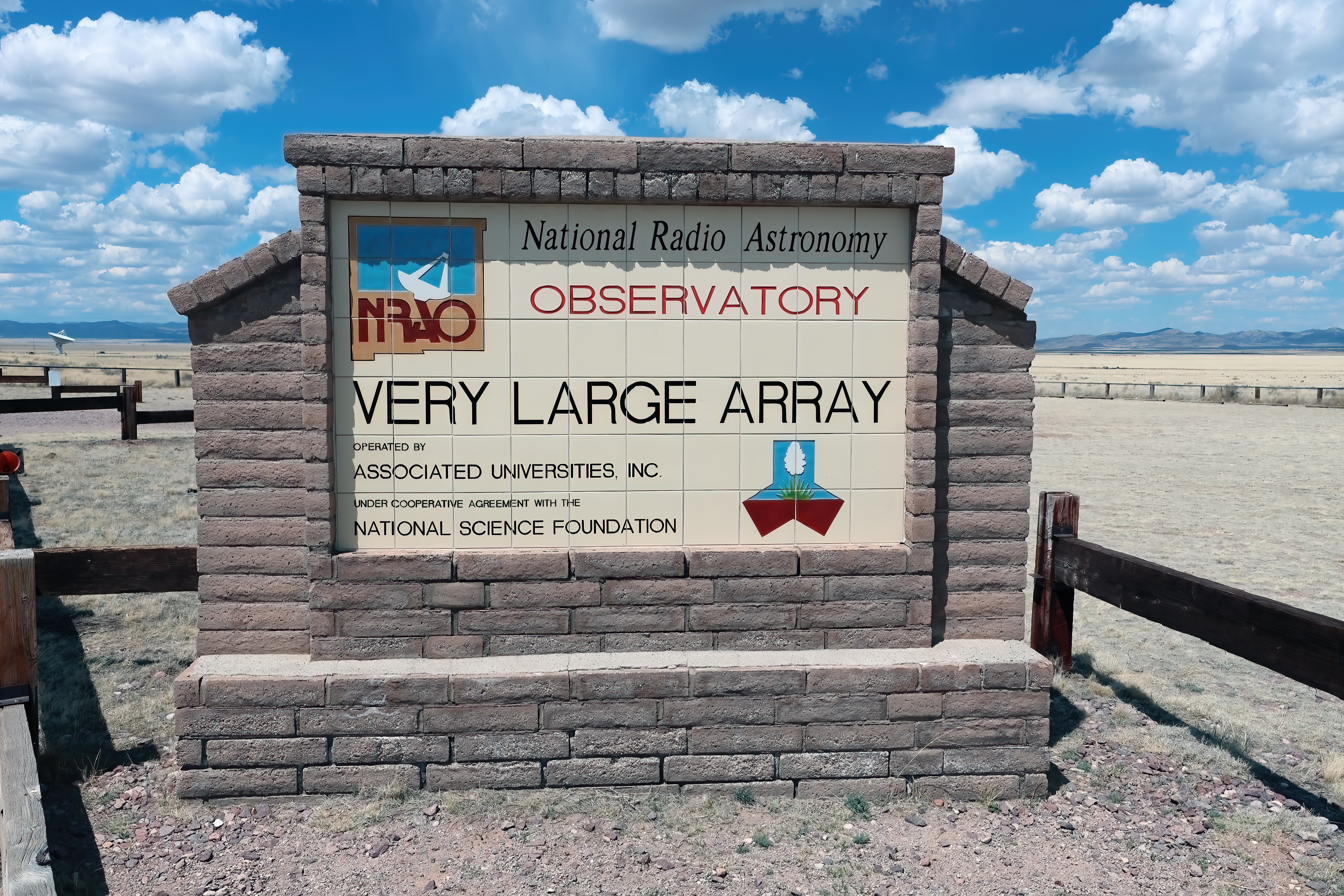
Official sign of the Karl G. Jansky Very Large Array near the entrance of the observatory in New Mexico, photographed during the day.
VLA Sign

The Karl G. Jansky Very Large Array (VLA) was also featured prominently in the 1997 science fiction film "Contact", based on the novel by Carl Sagan. The film tells the story of a scientist named Ellie Arroway, played by Jodie Foster, who uses the VLA to search for extraterrestrial intelligence.

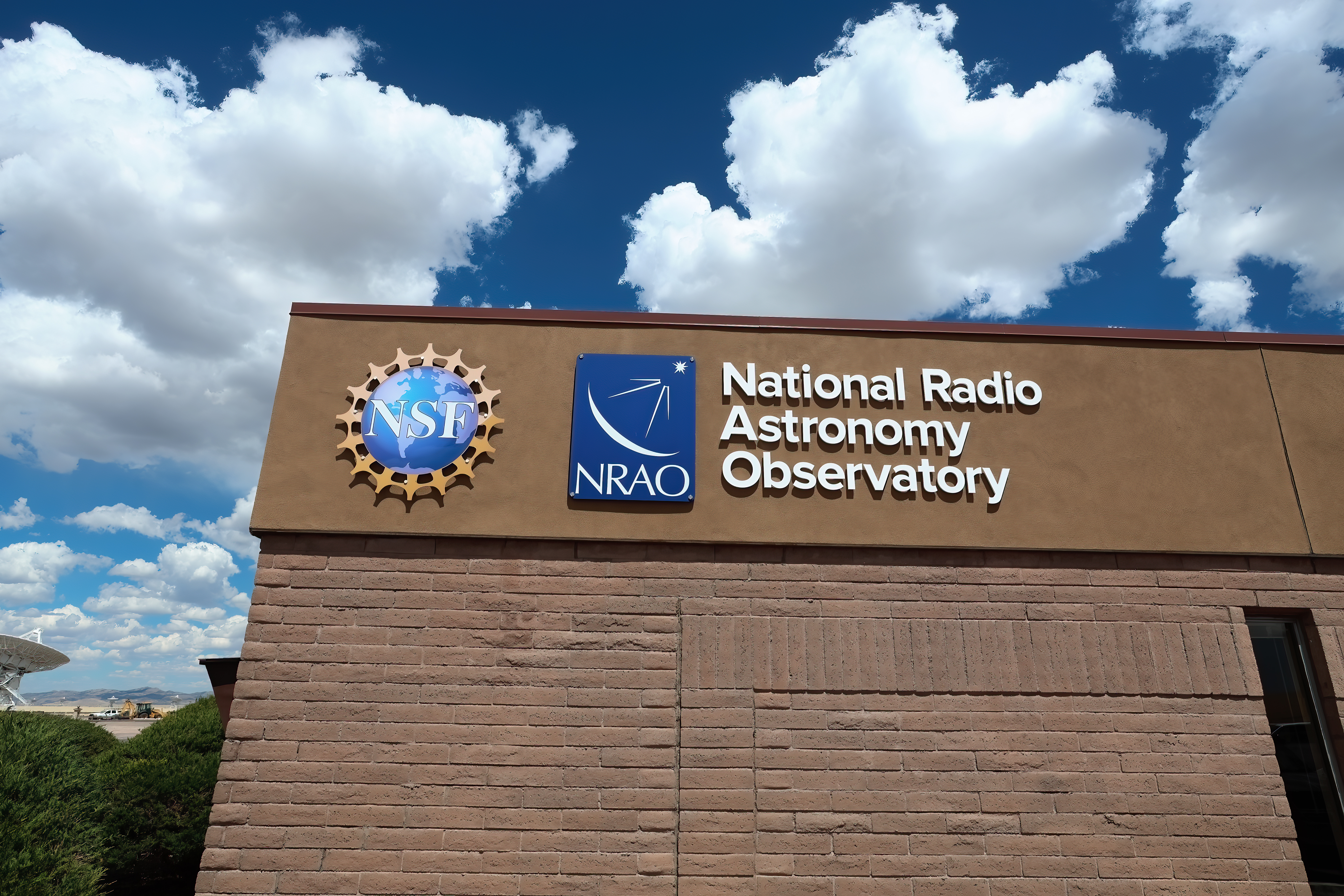
National Radio Astronomy Observatory building at the Karl G. Jansky Very Large Array site in New Mexico, photographed during the day.
NRAO

In the film, Arroway and her team use the VLA to search for signals from other civilizations in the universe. The VLA's ability to detect faint radio signals from distant objects is crucial to their search, as they believe that other intelligent beings may use radio waves to communicate with one another.

Single radio telescope dish at the Karl G. Jansky Very Large Array in New Mexico, part of the National Radio Astronomy Observatory, photographed during the day.
Radio Telescope

"Contact" is a science fiction film that features the Karl G. Jansky Very Large Array as a key element in its plot. Although the film's depiction of the VLA is largely fictional, it did raise awareness of the observatory and its capabilities among the general public. The VLA remains a powerful tool for scientific research, and its ongoing use by astronomers and other scientists continues to expand our understanding of the universe.

Line of four radio telescope dishes at the Karl G. Jansky Very Large Array in New Mexico, part of the National Radio Astronomy Observatory, photographed during the day.
VLA

I have only one day and night to make photos. Weather was not perfect. But I thing clouds give some drama to these photos.

Related Astrophotography Posts

Explore more observatories and astrophotography projects from my travels around the world:

Thursday, April 20, 2023

Night Sky After Snowstorm and Zodiacal Light — Great Sand Dunes National Park Astrophotography

 Great Sand Dunes National Park and Preserve, located in southern Colorado, is a unique and breathtaking destination that offers incredible opportunities for astrophotography. The park is home to the tallest sand dunes in North America, which rise over 750 feet high against the backdrop of the Sangre de Cristo Mountains. 

With its remote location, low light pollution, and clear skies, Great Sand Dunes National Park and Preserve is the perfect place for stargazing and capturing stunning photographs of the night sky.

As an avid amateur astrophotographer, I am always on the lookout for unique and breathtaking locations to capture in my photography. When I heard about the incredible natural beauty of Great Sand Dunes National Park and Preserve, I knew that I had to visit and see it for myself.


Milky Way and stars above snow-covered dunes after a snowstorm at Great Sand Dunes National Park, Colorado — night astrophotography with Canon EOS Ra.
Night Sky over Snow-Covered Dunes After a Snowstorm — Great Sand Dunes National Park

Canon EOS Ra, EF16-35mm f/2.8L II USM Lens, f/2.8, ISO 25600, 13 sec. Post processing: Photoshop and Topaz AI.

This photo was taken at midnight about 1 hour after a snowstorm had passed through the area. The snow on the dunes provided a striking contrast against the dark night sky, creating a dramatic and almost otherworldly atmosphere. 

One particularly interesting element in the photo is the air glow. Air glow is a natural phenomenon that occurs when atoms and molecules in the Earth's atmosphere emit light. This can create a soft, diffuse glow in the sky that becomes visible in long-exposure photographs. The green, yellow, and red colors are produced by different atmospheric emissions — primarily oxygen and hydroxyl molecules — creating the natural phenomenon known as airglow.

Dark clouds are also visible in the image, drifting slowly above the dunes. These are ordinary atmospheric clouds on Earth, captured during the long exposure shortly after the snowstorm passed. Against the background of thousands of stars, the clouds appear almost black, which is another indication of how dark the sky was that night. In locations with significant light pollution, clouds usually appear bright or orange due to reflected city lights, but here they remain nearly black.

It was a moment that I will never forget, and a photo that I will treasure for years to come. I feel so lucky to have been able to capture this photo, and I hope that it inspires others to get out there and explore the wonders of our natural world.

Below are a few additional night photos taken during this visit to Great Sand Dunes National Park, capturing different perspectives of the desert landscape under the Colorado night sky.


Great Sand Dunes National Park entrance sign under a clear starlit sky — nightscape astrophotography by astroval, Colorado.
Where desert meets the cosmos — the Great Sand Dunes National Park sign standing under a river of stars

Taking a photograph near the park entrance sign has become a small tradition for many visitors to Great Sand Dunes National Park. I followed the same tradition — but with a twist typical for an astrophotographer. Instead of a daytime photo, I captured the sign at night, standing quietly beneath a sky filled with thousands of stars.


Orion constellation, Venus and Zodiacal Light rising above Great Sand Dunes National Park, Colorado — nightscape astrophotography with Canon EOS Ra.
Colors of the night — Orion emerges over the silent dunes while Zodiacal Light rises through Venus along the ecliptic above Great Sand Dunes National Park.

Canon EOS Ra, EF16-35mm f/2.8L II USM, 16mm, f/2.8, ISO 25600, 15 sec.

Captured the night after a snowstorm passed through the area. This image shows Orion rising above the dunes, Venus near the horizon, and Zodiacal Light extending upward along the ecliptic under Bortle Class 2 skies. Unlike the previous photo, the dunes here are free of snow, revealing the desert landscape beneath the winter sky.

The final image in this series reveals another subtle astronomical phenomenon. Near the horizon the bright object is the planet Venus, often called the Evening Star when it shines in the sky after sunset. Passing upward through Venus is a faint triangular glow known as the Zodiacal Light.

Zodiacal Light is sunlight reflected from countless microscopic dust particles orbiting the Sun in the plane of the Solar System. Because the dust lies along the ecliptic — the same path followed by the planets — the glow appears as a tilted column of light rising along the zodiac constellations. In this image the glow extends upward through Venus and into the sky above Orion.

This phenomenon is extremely difficult to see from light-polluted areas and usually becomes visible only under very dark skies. The observation at Great Sand Dunes National Park was made under approximately Bortle Class 2 conditions, which allowed the Zodiacal Light to stand out clearly in the long-exposure photograph.

Interestingly, I did not recognize the Zodiacal Light when the photo was taken. Only later, while processing the image and verifying the sky orientation with astronomy software Stellarium, did it become clear that the faint glow aligned perfectly with the ecliptic.

This became the third location where I was able to capture Zodiacal Light in my astrophotography:

Together these observations show how truly dark skies — deserts, high plateaus, and remote national parks — allow us to photograph faint natural light phenomena that are completely invisible from most populated regions of the world.

Great Sand Dunes National Park and Preserve is also recognized as an International Dark Sky Park, making it one of the best locations in the United States for stargazing and night sky photography. The combination of high elevation, dry Colorado air, and minimal light pollution allows faint natural phenomena such as airglow and Zodiacal Light to become visible under good conditions.

For astrophotographers, the park offers a rare landscape where towering desert dunes, alpine mountains, and an exceptionally dark sky come together to create dramatic nightscape compositions.


Related Astrophotography Posts


Sunday, March 5, 2023

The SpaceX launch seen over Saint Martin Island on the evening of February 27, 2023

On the evening of February 27, 2023, around 7:20 PM local time, I witnessed an unexpected sky phenomenon above Saint Martin Island. While having dinner at the Java Restaurant in Grand Case, a bright, expanding plume appeared over the Caribbean horizon — a SpaceX launch carrying Starlink v2 Mini satellites into orbit from Cape Canaveral, Florida.

I wasn’t prepared at all, so these photos were captured using only a smartphone. Post-processing was later done in Photoshop and Topaz AI to enhance clarity. Despite the limitations of cellphone photography, the moment was unforgettable.

SpaceX Starlink v2 Mini launch creating glowing 'space jellyfish' plume over Saint Martin Island at twilight
SpaceX Starlink launch creating the “Space Jellyfish” effect above Saint Martin, February 27, 2023

These photos capture the SpaceX, launching first Starlink v2 Mini satellites into orbit. The SpaceX Launch was from Cape Canaveral in Florida, which is located approximately 1,300 miles (2,100 km) from Saint Martin Island.


Close-up of illuminated SpaceX rocket plume forming a luminous jellyfish shape above the Caribbean sky
The SpaceX launch first batch of second-generation Starlink internet satellites Seen Across Saint Martin Night

These photos capture the beauty of the rocket plume as it glows and reflects sunlight from high altitudes. The plume appears as a bright, luminescent trail that arcs across the sky, creating a stark contrast against the darkness of the night sky. This effect called Space jellyfish (or jellyfish UFO or rocket jellyfish). 

Wide view of Saint Martin harbor with SpaceX rocket trail glowing above the Caribbean horizon after sunset
The SpaceX launch seen over Saint Martin Island on the evening of February 27 2023

Looks like this is new attraction on Caribbean islands now!

SpaceX Launch as a Modern Sky Phenomenon

Although this event was created by human technology, the visual effect in the sky is governed by the same physics that shape many natural sky phenomena.

After sunset, the lower atmosphere above Saint Martin was already in darkness. However, at high altitude, the rocket plume remained illuminated by sunlight. This contrast between shadowed ground and sunlit upper atmosphere created the glowing “space jellyfish” effect.

The phenomenon occurs because the expanding exhaust gases reach altitudes where they still reflect direct sunlight, while observers on the ground stand in twilight or darkness. It is the same geometric principle that makes high-altitude clouds glow after sunset.

In this sense, the SpaceX launch becomes part of a broader category of Sky Phenomena — visible interactions between light, atmosphere, and space.

Related Astrophotography & Sky Phenomena Posts

These posts explore how celestial light, atmosphere, and even modern space technology create extraordinary visual effects in the sky.

Wednesday, November 2, 2022

Rainbow Milky Way Joshua Tree National Park

This image represents a large-scale panoramic Milky Way photograph captured at Joshua Tree National Park.

The final image is a wide-field panorama composed of 40 individual exposures, stitched together to reveal the full Milky Way arch stretching across the desert sky. This post focuses on the panoramic process itself — showing the individual frames, the intermediate stitched result, and how the final image was formed.

Milky Way panorama: 40 images
Canon EOS Ra, EF 16–35mm f/2.8L II USM
f/2.8 · ISO 25600 · 4.8 sec

Rainbow Milky Way arch over Joshua Tree National Park — 40-photo panorama by astroval.
Rainbow Milky Way Joshua Tree National Park

Below are examples of individual frames used to build the panorama. Each image captures only a small section of the sky, but together they form the complete Milky Way arch.

Single exposure for Milky Way panorama at Joshua Tree National Park.
Single photo 1 for Panorama

Single photo 2 for Panorama

Single photo 3 for Panorama

Single photo 4 for Panorama

After capturing all frames, I used Photoshop → File → Automate → Photomerge to stitch the images into a single panorama.

Milky Way panorama after initial Photomerge in Photoshop — curved horizon before geometric correction, Joshua Tree National Park.
Panorama after Automate Photomerge

At this stage, the Milky Way arch was complete, but the horizon appeared noticeably curved — a common effect of automated panorama stitching. The software prioritizes smooth blending between frames, often at the expense of geometric realism.

In the final step, I manually corrected and leveled the horizon in Photoshop using Select → All followed by Edit → Transform → Warp, while preserving the true curvature of the Milky Way. This transformation turned the temporary stitched image into the final panoramic photograph shown at the top of the post — closely matching how the scene appeared under the dark skies of Joshua Tree National Park.

Related Astrophotography Posts

Joshua Tree National Park

Rainbow Milky Way & Milky Way Panoramas